What Happens If My Supplier Sends the Wrong Goods?
What happens if a Chinese supplier sends the wrong goods? Learn how to handle disputes, get refunds, and prevent errors before shipping.
GROWING BUSINESSGETTING STARTED
Jacob Ehigie
2/24/20267 min read
You waited 30 days for your sea shipment to arrive. You clear customs, pay your agent, arrange delivery — and when you finally open the cartons, you find the wrong colour, the wrong size, or a completely different product from what you ordered.
It is one of the most frustrating things that can happen to an importer, and it happens more often than most people talk about. The good news is that receiving wrong goods from a Chinese supplier does not have to mean losing your money. If you know the right steps to take — and more importantly, the right steps to take before goods leave China — you can protect yourself, get your replacement or refund, and avoid the problem entirely on future orders.
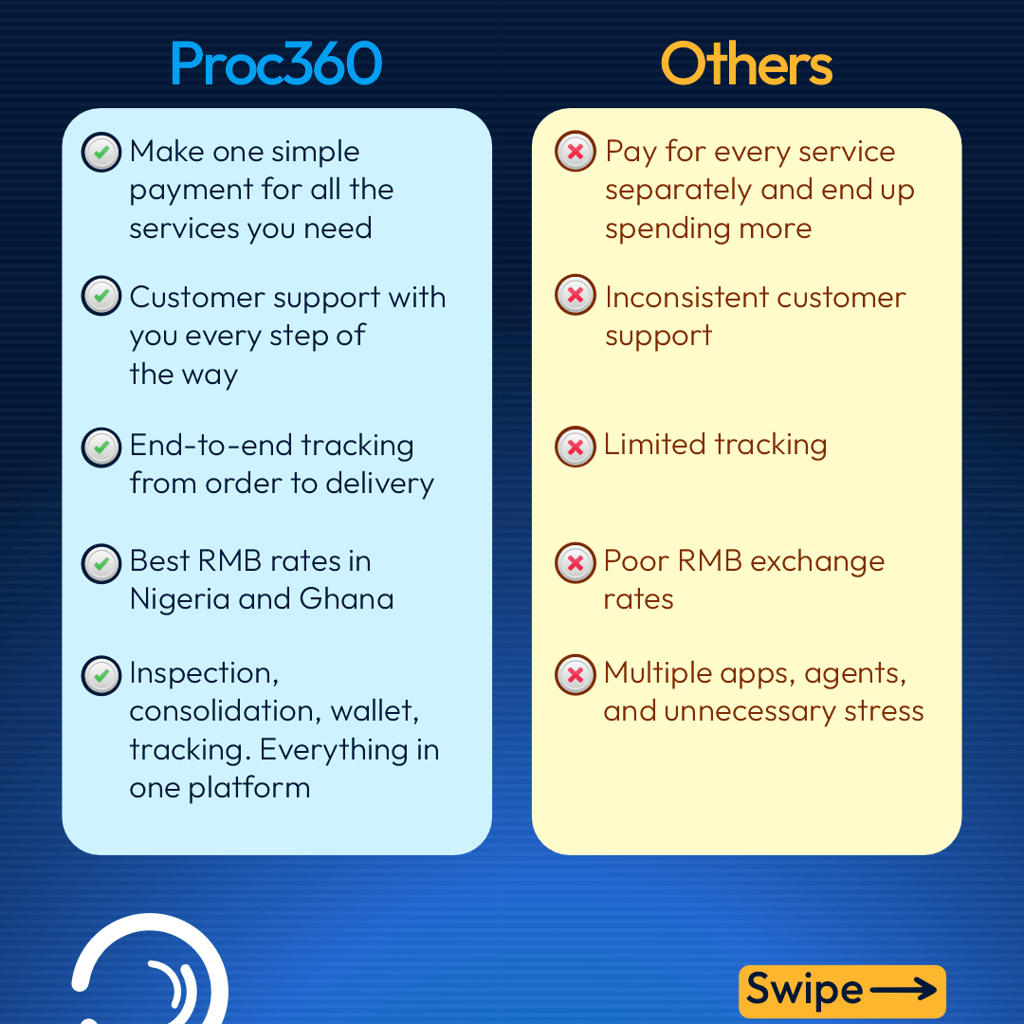
With Proc360, you can request a quality check on your goods at the China warehouse before they ship — verifying quantities, product specs, and condition while there is still time to fix any errors without an international dispute.
Why Do Suppliers Send the Wrong Goods?
Understanding why wrong shipments happen helps you prevent them. The most common causes are not malicious — they are operational.
Specification misunderstandings. This is the leading cause. If your order does not clearly define colour, size, model number, material, or quantity per carton, the supplier fills the gaps with their own assumptions. What you picture and what they produce can be two very different things.
Mixed inventory errors. In busy factories and warehouses, especially during peak production periods, goods from different orders get mixed up during packing. Your cartons leave with someone else's products inside, and neither party knows until the shipment arrives.
Product substitution without notice. A supplier runs out of a specific variant and substitutes a similar one without telling you. They may consider it close enough. You may not agree.
Language and translation errors. Even with Google Translate, ordering from Chinese platforms without a bilingual intermediary creates room for misinterpretation — especially for technical specifications, colour names, or product codes that do not translate cleanly.
Knowing which of these caused your wrong shipment matters because it determines your strongest argument when you contact the supplier for a resolution.
Your Best Protection: Request a Quality Inspection Before Goods Ship
The single most effective way to handle wrong goods from a Chinese supplier is to catch the error before the goods leave China. Once your shipment is on the water and headed to Nigeria, your options become significantly more expensive and time-consuming. A pre-shipment inspection changes the entire equation.
A pre-shipment inspection — also called a quality check — is a review of your goods at the supplier's factory or at a consolidation warehouse after production is complete but before shipping is confirmed. There are four main types of quality inspections importers use:
1. Pre-Production Inspection (PPI): Checks raw materials and components before manufacturing starts. Useful for custom or high-specification orders.
2. During Production Inspection (DPI): Conducted mid-production to catch defects early. Best for large or complex orders where catching errors halfway is still cheaper than scrapping the full batch.
3. Pre-Shipment Inspection (PSI): The most commonly used type for Nigerian importers. Conducted when at least 80% of your order is complete and packed, before it leaves the factory or warehouse. This is your last clear opportunity to verify that what is in the boxes matches what you ordered.
4. Container Loading Inspection: A real-time check that goods going into a shipping container match your order. Useful for very large shipments where loading errors can be significant.
For most importers sourcing from China to Nigeria, the pre-shipment inspection is the priority. When you use Proc360's Store feature, your goods arrive at a personal China warehouse where you can request a quality check — verifying product appearance, quantity, and condition before a single kilogram is shipped. At $0.50 per parcel, it is one of the lowest-cost insurance decisions in your entire import process.
What Proc360's Buy For Me Protects Against
When you place an order through Proc360's Buy For Me feature, your product request — whether submitted by link, photo, or description — is sourced from verified suppliers who have established export track records. The platform communicates in Chinese directly with the supplier, which removes the specification translation errors that cause most wrong shipment problems in the first place.
If you use the Store feature and request a quality check before shipping, your goods are verified at the China warehouse before they leave. That means errors in colour, size, quantity, or product type are identified while the supplier can still correct them — not after 35 days on a vessel and a customs clearance bill. Sign up at Proc360 and make pre-shipment verification part of every order you place from China.
Sourcing from China and want to verify your goods before they ship? Create your free Proc360 account and request a quality check on your next order — before a single kilogram leaves China.
What to Do When You Receive Wrong Goods
If wrong goods have already arrived, move quickly and methodically. How you handle the first 48 to 72 hours will significantly affect your outcome.
Document everything before you unpack further. Take clear photos and videos of the packages as they arrived — outer cartons, labels, seal condition, and the contents as you open each box. This visual evidence is your primary proof in any dispute. Record product codes, quantities, colours, and anything that differs from your purchase order.
Compare against your original order documentation. Pull up your purchase order, product specification sheet, and any photos or samples you approved before production. Write down every specific discrepancy: wrong colour, wrong size, wrong quantity, wrong model. The more specific your list, the stronger your position with the supplier.
Contact the supplier immediately with evidence. Do not wait. Send your documented evidence — photos, video, and a written summary of the discrepancies — directly to your supplier contact within 48 hours of receiving the goods. Use a clear, professional tone. State what was ordered, what arrived, and what resolution you are requesting: replacement, partial refund, or credit on your next order.
Use this message structure when contacting the supplier:
"Dear [Supplier Name], I received my order [Order Number] on [Date]. After inspection, I found the following discrepancies versus my purchase order: [List specific issues]. I have attached photos and video as evidence. Please confirm receipt of this message and advise on the steps to resolve this. I am requesting [replacement/partial refund/credit]. I look forward to your response within 48 hours."
Escalate through the platform if unresolved. If you ordered through Alibaba, raise a dispute through Trade Assurance — this is what the escrow service exists for. Submit your evidence through the platform and let the formal process begin. If you ordered directly through 1688 or a direct factory relationship without platform protection, your leverage comes from your relationship, your documentation, and the prospect of future orders.
Know when to accept a partial resolution. In many cases, a Chinese supplier will offer a partial refund — typically 20 to 50% of the product cost — rather than the full replacement cost, especially if reshipping an entire order is logistically complex. Evaluate whether the partial refund gets you to a workable position, factoring in your cost of goods and what you can still sell from the wrong shipment.
How to Request a Refund or Replacement Professionally
Whether you are asking for a replacement shipment or a monetary refund, the way you make the request affects the outcome. Suppliers respond better to buyers who are specific, calm, and well-documented than to those who are vague or aggressive.
For a replacement: Request that the correct goods are shipped at the supplier's cost, and that they confirm the corrected specifications in writing before production or dispatch. Ask for a revised packing list and photo confirmation before the replacement ships — do not repeat the same process without verification.
For a refund: State the specific amount you are requesting based on the discrepancy. If half the order is wrong, request a refund for that half. Provide a breakdown so the supplier understands the basis of your claim. Offer to return the wrong goods if the supplier covers return shipping — but do not commit to returning at your own cost unless the supplier is offering full replacement value.
Set a timeline: Give the supplier a reasonable but firm deadline. "Please respond within 5 business days" is reasonable for an initial response. "Please confirm the replacement shipment date within 10 business days" is reasonable for resolution. Deadlines move conversations forward.
How to Avoid Wrong Shipments on Future Orders
The most effective dispute is one you never have to make. These steps, built into your ordering process, significantly reduce the chance of receiving wrong goods:
Always order samples before bulk. A sample confirms exactly what the supplier produces for your specification. It creates a physical reference point that both you and the supplier can match against. If the bulk order does not match the sample, that is your clearest evidence.
Provide detailed, written product specifications. Do not rely on a product link alone. Send a specification sheet that includes: exact colour (use Pantone or RAL codes where possible), material, dimensions, weight, model number, quantity per carton, and labelling requirements. The more specific you are, the less room the supplier has to make assumptions.
Request pre-shipment photo or video confirmation. Before goods leave the factory, ask your supplier to send photos or a short video of the packed goods. This takes them two minutes and gives you visual confirmation of quantities, labelling, and product appearance before shipping is booked.
Use Proc360's quality check before every shipment. When your goods arrive at the Proc360 China warehouse, request a quality inspection before confirming the shipment. At $0.50 per parcel, a quality check verifies product appearance and quantity against your order — catching errors at the point where they are still cheap to fix, not after a 40-day sea voyage.
Put your specifications in writing on every order. Even with a supplier you have used before, confirm your specs in writing each time. Factories change staff, production lines change, and assumptions build up over repeat orders. A written confirmation protects you even in a relationship you trust.