Should You Split Your Order? When 2 Shipments Cost Less Than 1
Sending everything at once isn’t always cheaper. Discover when splitting your shipment can save you thousands and improve your cash flow.
GROWING BUSINESSGETTING STARTED
Jacob Ehigie
3/16/20266 min read
Most Nigerian importers assume that sending everything in one shipment is always the cheaper option. One trip, one bill, done. But that is not always true — and the difference can be tens of thousands of naira on a single order.
Depending on your product weight, urgency, and customs exposure, splitting your order into two shipments — one by air and one by sea — can reduce your total shipping cost, get part of your inventory to market faster, and protect your cash flow while you wait for the bulk to arrive.
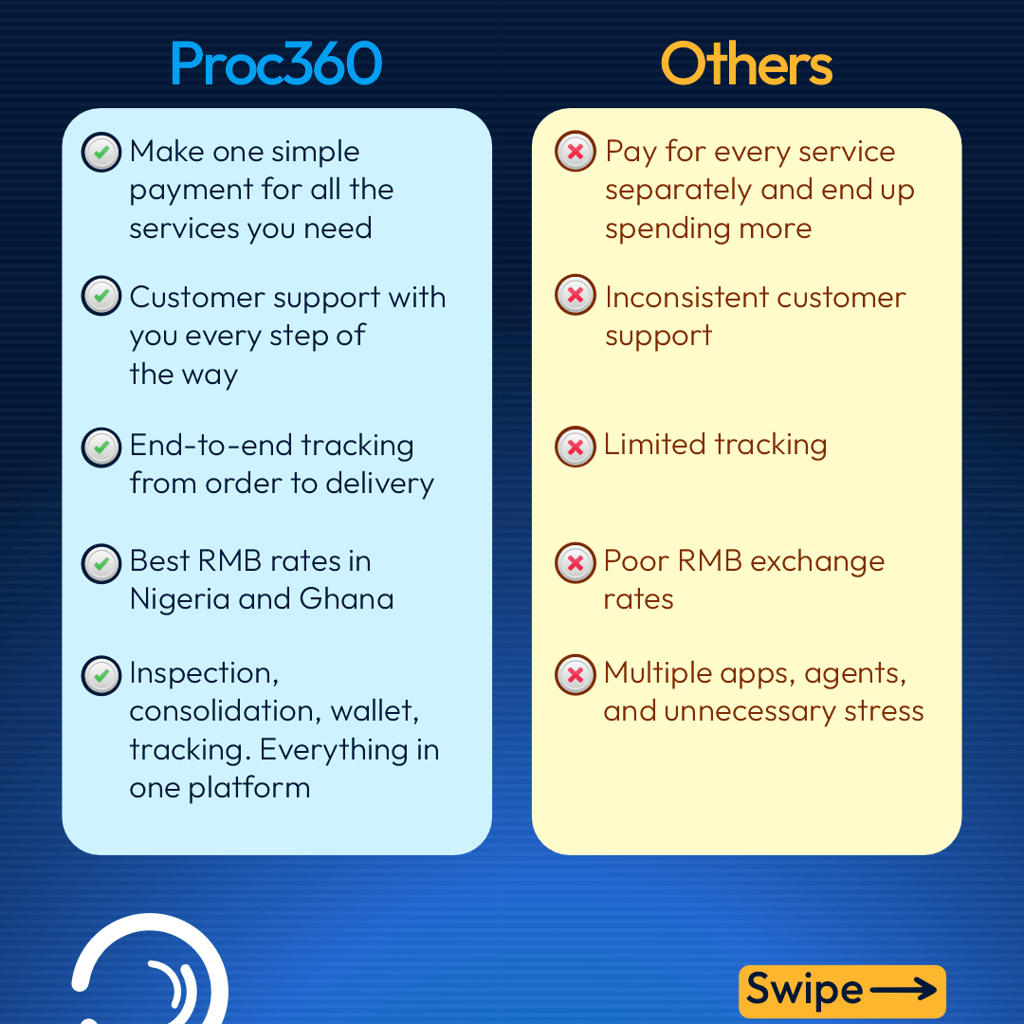
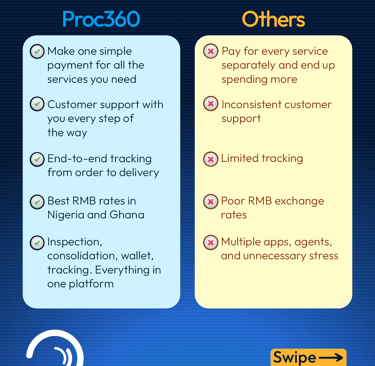
With Proc360, you can consolidate goods from multiple suppliers into one shipment, use the built-in shipping cost calculator to compare air and sea rates in real time, and make the split shipment decision with actual numbers in front of you — not guesswork.




What Is Split Order Shipping?
A split shipment — sometimes called split delivery — means dividing a single order into two or more separate shipments that travel by different routes, methods, or at different times. For importers sourcing from China to Nigeria, this usually means sending a smaller portion by air freight and the larger bulk by sea freight.
Split shipments are not the same as placing two separate orders. You are ordering the same goods, from the same supplier or multiple suppliers, but choosing to ship them in two batches based on what makes financial or logistical sense. The goal is to balance speed and cost in a way that a single shipment — entirely by air or entirely by sea — cannot always achieve on its own.
The Real Cost of Shipping From China to Nigeria
Before you can decide whether to split an order, you need to understand how shipping is priced. Both air and sea freight use different calculations, and knowing which one applies to your goods determines everything.
Air freight is charged by actual weight or volumetric weight — whichever is higher. Proc360's current air freight rate to Nigeria is $10.40/kg for normal goods and $11.60/kg for special items. Air shipments typically arrive in 7 to 14 days, making them ideal for fast-moving or time-sensitive goods.
Sea freight is charged by cubic metre (CBM). Proc360's current sea freight rate to Nigeria is $355 per CBM. Sea shipments take 35 to 45 days but offer significantly lower cost per unit for heavy or bulky goods.
The break-even point — where air and sea cost roughly the same per unit — sits around 200kg for most standard consumer goods. Below that, air freight is sometimes competitive when you factor in the speed advantage. Above it, sea freight almost always wins on cost. A split shipment strategy takes advantage of both sides of that equation at the same time.
When 2 Shipments Actually Cost Less Than 1
Here is the scenario where splitting saves you money. Assume you have ordered 300 units of a product — 80kg worth of fast-selling items you need quickly, and 220kg of slower stock you can afford to wait on.
Option A — Single air shipment (300kg total): At $10.40/kg, that is $3,120 in freight alone. Plus processing fees.
Option B — Split shipment (80kg air + 220kg sea): Air cost: 80kg × $10.40 = $832. Sea cost: estimated 0.8 CBM × $355 = $284. Total freight: $1,116. That is a saving of over $2,000 on freight alone — and your fast-moving stock arrives in under two weeks while the bulk follows by sea.
The savings are not always this dramatic, but the principle holds across most product types. When part of your order is genuinely urgent and part is not, a split shipment lets you stop paying air rates for goods that do not need to arrive by air.
How Proc360 Makes Split Shipments Easier to Manage
When you ship through Proc360, your goods arrive at a personal warehouse in China where you have 30 days of free storage. This means you can receive goods from multiple suppliers, consolidate what is going by sea, and send the air portion immediately — all from a single dashboard without coordinating with multiple freight agents.
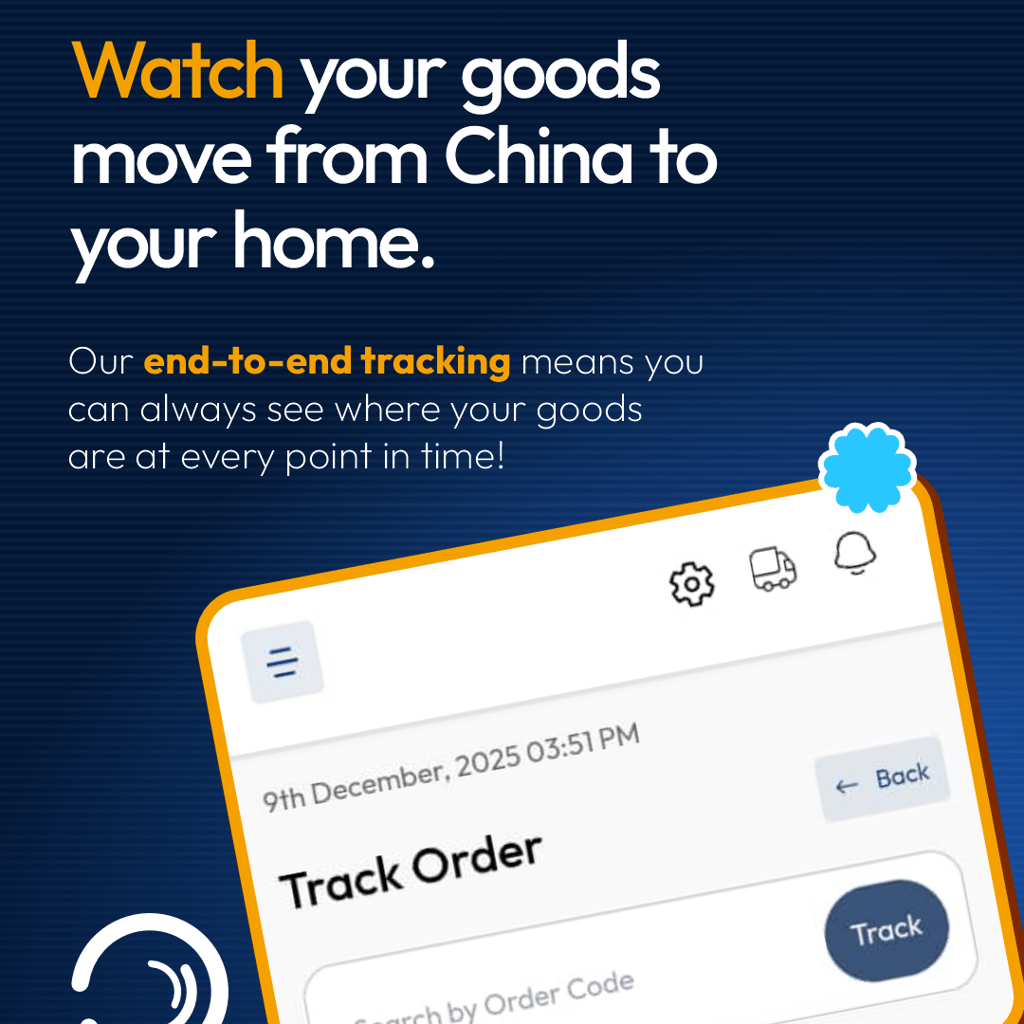
You track both shipments in real time from the app, so you always know exactly where each consignment is — whether it landed at Murtala Muhammed International Airport or is still on the water. And because consolidation is free on Proc360, combining multiple supplier orders into the sea shipment does not add to your freight bill.
Want to calculate whether a split shipment makes sense for your next order? Sign up on Proc360 and use the shipping cost calculator to compare air and sea rates in real time — with free consolidation, 30 days of free storage in China, and doorstep delivery to Nigeria or Ghana.
When Is a Single Shipment Still the Better Choice?
Splitting is not always the right call. There are situations where a single consolidated shipment is cheaper and simpler:
Your entire order is lightweight and urgent. If all your goods are under 50kg and you need them fast, a single air shipment is your cleanest and most cost-effective option. Splitting adds logistics complexity without saving much.
Your goods are too heavy to justify any air freight. If everything you are importing is bulky — furniture, large machinery parts, heavy tools — sea freight is the obvious answer for the whole order. There is no benefit to splitting when no portion of the goods justifies the air rate.
Your total volume barely fills a sea shipment minimum. LCL sea freight has minimum charges, typically around 0.5 CBM. If splitting your order means one batch is too small for LCL to be cost-effective, consolidating everything into one sea shipment is better.
Your products have synchronised sales timelines. If you sell everything together — for example, a bundled product set — receiving half by air and half by sea weeks later creates fulfilment problems. A split only works if the two portions can be sold or used independently.
How to Calculate Whether a Split Shipment Makes Sense
Before you decide, run this quick calculation:
Get the total weight and volume of your order. Your supplier can provide this on the packing list. Confirm both actual weight in kg and dimensions in cm so you can calculate CBM (Length × Width × Height ÷ 1,000,000).
Identify which portion is time-sensitive. Ask yourself honestly — which part of this order do I need in the next 14 days? That portion goes air. The rest goes sea.
Calculate air cost for the urgent portion. Multiply the weight of your urgent goods by the current air rate ($10.40/kg for normal goods on Proc360). Add processing fees.
Calculate sea cost for the bulk. Multiply the CBM of your remaining goods by the sea rate ($355/CBM on Proc360). Add processing fees.
Compare the total split cost against a single shipment. If the combined cost of air + sea is lower than sending everything by air, and you can tolerate the wait on the sea portion, the split shipment wins.
Use Proc360's shipping cost calculator to get real-time rates for both methods before you commit. The calculator lets you enter your cargo dimensions and weight and compare air versus sea costs instantly — no freight forwarder call required.
Split Shipments and Customs Duties — What You Need to Know
One concern importers raise about split shipments is customs exposure. In Nigeria, import duties are calculated on the CIF value — cost of goods plus insurance plus freight. A lower CIF value means a lower duty bill.
When you split a shipment, each consignment is assessed separately. If your air shipment carries higher-value goods and your sea shipment carries lower-value bulk items, your duty per shipment reflects each parcel's individual CIF. In some cases, this creates an opportunity to time your shipments around cash flow — but it is important to declare accurately and not to undervalue goods. Customs penalties for misdeclaration are significantly more expensive than any duty savings.
What splitting does help with legitimately is managing large lump-sum duty payments. Instead of facing a single large customs bill on the full order, two smaller bills arrive at different times — which can be easier to manage from a cash flow perspective.
The Decision Framework: Should You Split?
Use this quick checklist before your next order:
✅ Split your order if: part of your stock is urgent and time-sensitive, the remaining goods are heavy or bulky, the air cost savings on the bulk portion are significant, and you can sell or use the two batches independently.
✅ Split your order if: you are launching a new product and want a small quantity to land fast for testing, while the larger restock follows by sea.
❌ Keep it in one shipment if: all goods are the same urgency level, the weight difference does not justify two sets of processing fees, or your order is too small for sea freight to be viable.
❌ Keep it in one shipment if: you are sourcing from multiple suppliers and Proc360's consolidation feature can combine everything into one sea shipment at no extra freight cost — which is often cheaper than splitting at all.