Sea Freight From China to Nigeria: Everything You Need to Know (Types, Costs, and How to Calculate Your Shipping)
Learn how sea freight from China to Nigeria works. Compare FCL vs LCL, understand costs, transit time, and calculate your shipping accurately.
GROWING BUSINESSGETTING STARTED
Jacob Ehigie
4/1/20268 min read
You’ve found your supplier. You’ve agreed on a price. Now comes the part that quietly makes or breaks your profit margin — choosing the right shipping method and understanding exactly what you’re paying for.
Sea freight is the most cost-effective way to move goods from China to Nigeria, especially for bulk orders. But most importers treat it like a black box: they get a rate, pay the invoice, and hope the numbers work out. The problem is that sea freight pricing has layers. If you don’t understand those layers before you order, you end up surprised at checkout.
This guide breaks it all down: the two types of sea freight, what drives the cost, current 2026 rate ranges, and a step-by-step method to estimate your shipping cost before your goods even leave China.
Want to start importing by sea freight? Sign up on Proc360 for free →



FCL vs LCL: Which Type of Sea Freight Is Right for Your Shipment?
Before you can calculate your cost, you need to know which type of sea freight applies to your shipment. There are two options: FCL and LCL.
FCL — Full Container Load
With FCL, you rent an entire shipping container — either a 20ft or 40ft — exclusively for your goods. Even if you don’t fill it completely, that container belongs to your shipment alone. A standard 20ft container holds roughly 25–28 CBM of cargo. A 40ft holds around 55–60 CBM.
FCL works best when:
Your shipment is 15 CBM or more
You’re importing high-value goods and want them handled separately
You need faster transit and fewer cargo handling touchpoints
You’re shipping a full product run for restocking
LCL — Less than Container Load
With LCL, your goods share a container with shipments from other importers. You only pay for the space your cargo actually occupies, measured in CBM (cubic metres). This makes it ideal for smaller or starter orders where you don’t yet have the volume to justify a full container.
LCL works best when:
Your shipment is under 15 CBM
You’re placing a test or first order and keeping upfront costs low
You’re sourcing from multiple suppliers and consolidating into one shipment
You want flexibility without committing to full container pricing
Quick rule of thumb: If your shipment is under 15 CBM, LCL is typically the better choice. Once you cross 15 CBM, compare LCL and FCL side by side — FCL often becomes cheaper per CBM at that threshold because the per-container cost gets spread across more goods.
Sea Freight Rates: China to Nigeria (2026)
Rates shift based on global shipping demand, fuel prices, port congestion, and seasonal factors. Here are the current reference ranges as of early 2026.
LCL Rates (per CBM)
LCL pricing is based on how many cubic metres your cargo takes up. As your shipment gets larger, the cost per CBM generally drops:
1–2 CBM: roughly $150–$200 per CBM
3–10 CBM: roughly $85–$150 per CBM
10–15 CBM: roughly $40–$85 per CBM
Important: Always confirm whether your quote is port-to-port or door-to-door. The gap between those two is where most hidden costs live.
FCL Rates (per container)
For full containers, the rate is a flat fee regardless of how much you fill the container:
20ft container: roughly $1,600–$2,800
40ft container: roughly $2,500–$4,200
These are ocean freight costs only. Customs clearance, terminal handling at Lagos ports, and doorstep delivery are billed separately on top of these rates (more on that in Section 4).
Proc360’s Sea Freight Rate
On Proc360, sea freight to Nigeria is currently priced at $390 per CBM — an inclusive rate covering packing, port handling, and delivery to the Lagos warehouse, with customs clearance included and no hidden fees. This rate applies to LCL-range shipments imported through the platform.
5 Things That Will Increase Your Sea Freight Cost (And How to Avoid Them)
1. Volumetric weight vs actual weight
For LCL shipments, you pay whichever is higher, your cargo’s actual weight or its volumetric weight. Bulky, lightweight goods like foam products or oversized packaging can end up costing far more than you’d expect. Ask your supplier to optimise carton dimensions and remove unnecessary outer packaging before your goods ship.
2. Peak season surcharges
Rates spike before Chinese New Year (January–February) and during Q4 demand surges ahead of the holiday season. If your timeline allows it, shipping during off-peak months, March through June, or August through September, typically gives you lower, more stable rates.
3. Restricted goods surcharges
Certain products face surcharges or outright restrictions on sea freight: lithium batteries, liquids, aerosols, and some electronics all fall into special cargo categories. If your goods are in one of these categories, confirm the classification and any additional fees before you book. Surprises here can be expensive.
4. Lagos port congestion fees
Apapa and Tin Can Island ports regularly face congestion, and carriers sometimes impose Port Congestion Surcharges (PCS) that aren’t included in your original quote. Ask your logistics provider whether a PCS is currently in effect before you lock in your rate.
5. Late booking
Booking last-minute almost always costs more. Vessel space tightens as departure dates approach, and rates reflect that. Booking 2–3 weeks ahead of your preferred sailing date gives you access to better rates and more container options.
How Sea Freight Works on Proc360
When you ship through Proc360, your goods go to your personal warehouse address in China first — whether you ordered through the platform or bought independently from 1688, Taobao, or any other Chinese marketplace. From there, you consolidate everything into one shipment before requesting sea freight.
This consolidation step alone can significantly reduce your per-CBM cost, because instead of paying separate freight on three small orders, you pay one rate on the combined shipment.
Here’s how the process works:
Your goods arrive at your Proc360 warehouse address in China
You store them free for up to 30 days while waiting for other orders to arrive
You request a quality check ($0.50 per parcel) to verify items before they leave China — optional but recommended
You consolidate all items from different suppliers into one shipment — free of charge
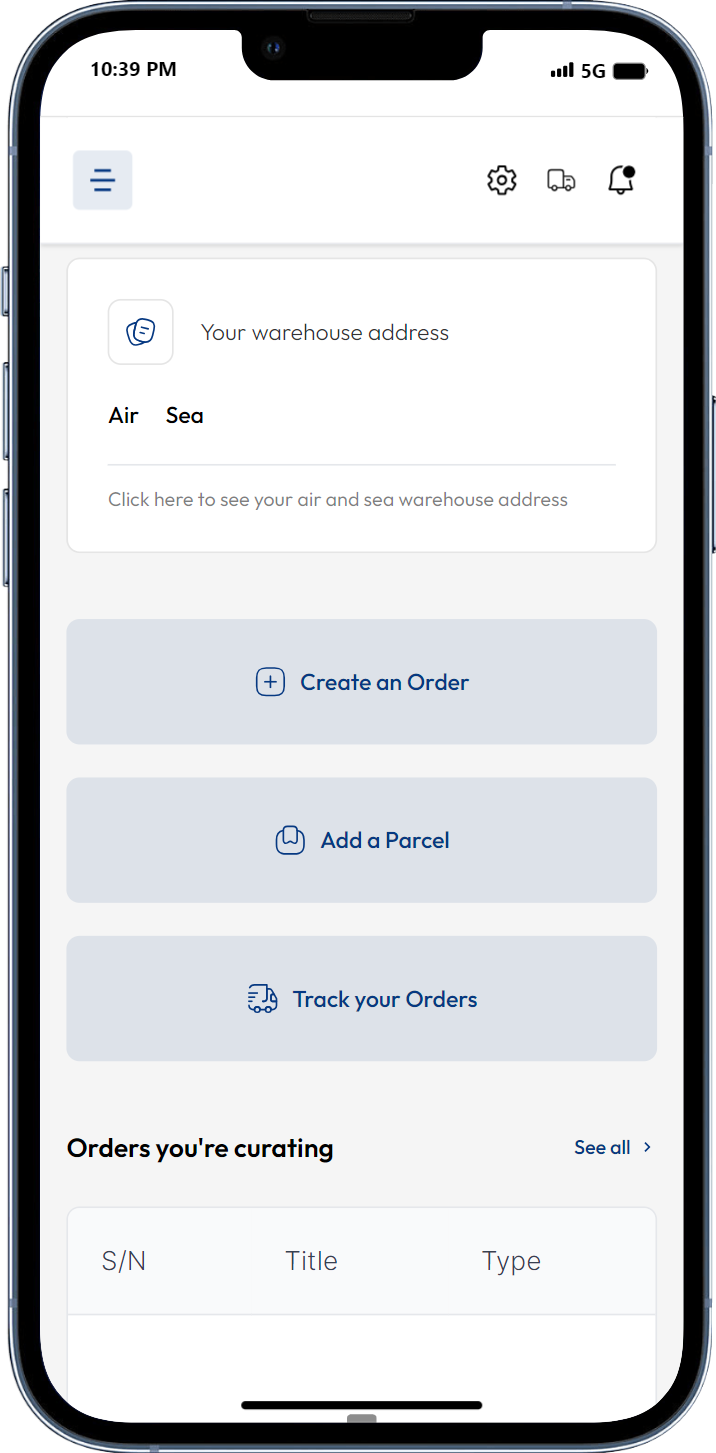
You apply for sea freight from your Proc360 dashboard and confirm the shipment details
Your goods are packed, export-cleared, and shipped to Lagos
Customs clearance is handled on arrival, and your goods are delivered to the Lagos warehouse for pickup or arranged for doorstep delivery
Sea freight rate: $390 per CBM (Nigeria)
Free storage: 30 days in your China warehouse while you consolidate orders
Consolidation: Free
Customs clearance: Included
First order: 100% free with no service charge
More than 8,000 African businesses already import through Proc360. Create your free account →
How Long Does Sea Freight Take? (China to Nigeria, 2026)
Sea freight from China to Nigeria currently takes between 35 and 45 days port-to-port, depending on where in China your goods are shipping from and the route the vessel takes.
Here’s a more specific breakdown by origin city:
Shenzhen or Guangzhou (South China) to Lagos: 30–40 days
Shanghai or Ningbo (East China) to Lagos: 35–45 days
LCL shipments from any Chinese port to Lagos: 38–48 days (add 5–10 days for deconsolidation)
These are port-to-port transit times only. Your real lead time is longer once you add customs clearance at Lagos (typically 3–7 days) and inland delivery to your final location.
One important note for 2026: with many vessels now rerouted via the Cape of Good Hope instead of the Suez Canal due to ongoing Red Sea disruptions, some routes are running 5–7 days longer than pre-2024 timelines. Build that buffer into your planning.
Lagos ports — both Apapa and Tin Can Island — also experience periodic congestion that can add clearance delays. The new Lekki Deep Sea Port has helped absorb some of the traffic, but congestion remains a real factor, especially in Q4.
What’s Actually in Your Sea Freight Quote? (The Hidden Costs Explained)
This is where a lot of importers get caught off guard. The “shipping rate” you see in a quote is almost never the full story. Here are the cost components you need to ask about before you book:
Ocean freight — the base rate for moving your container from a Chinese port to Lagos
Origin charges — container loading, export handling, and documentation fees in China
Destination charges — terminal handling and port congestion surcharges at Apapa or Tin Can Island
Customs clearance — import documentation processing and agent fees in Nigeria
Import duties and VAT — duties vary by product category; VAT is 7.5% on the CIF value of your goods
Inland delivery — trucking from the Lagos port to your warehouse or pickup point
Cargo insurance — optional but strongly recommended; typically 0.3–0.5% of your cargo’s declared value
In total, these additional charges can add 20–40% on top of the base ocean freight rate. Never budget based on the freight rate alone, always ask for a full landed cost breakdown.
On Proc360, the $390/CBM sea freight rate is structured to be inclusive of the core logistics costs from China to the Lagos warehouse, with customs clearance already covered. What you see is what you plan around.
How to Calculate Your Sea Freight Cost: Step-by-Step
Here’s the exact process to estimate your sea freight cost before you finalise your order.
Step 1: Calculate Your CBM
CBM (Cubic Metre) is the standard unit for sea freight pricing. You calculate it by multiplying your cargo dimensions in metres:
CBM = Length (m) × Width (m) × Height (m)
For multiple cartons, calculate the CBM of one carton and multiply by the total number of cartons.
Example: You’re shipping 30 cartons. Each carton measures 0.6m × 0.4m × 0.4m.
One carton: 0.6 × 0.4 × 0.4 = 0.096 CBM
30 cartons: 30 × 0.096 = 2.88 CBM total
Step 2: Decide FCL or LCL
Use your CBM figure to choose the right option:
Under 15 CBM → LCL is typically the right call
15 CBM and above → compare LCL vs FCL to see which works out cheaper per CBM for your shipment size
Step 3: Apply the Rate
For LCL: multiply your CBM by the rate per CBM.
Using our example: 2.88 CBM × $390 (Proc360’s sea rate) = $1,123.20 in base sea freight.
For FCL: your cost is the flat container rate (e.g. $1,600–$2,800 for a 20ft container), regardless of fill level.
Step 4: Add the Extra Charges
Your base freight figure is just the starting point. Layer in customs clearance, duties, VAT (7.5% on CIF value), and inland delivery to arrive at your true landed cost per shipment.
Step 5: Confirm Before You Commit
Manual calculations give you a solid ballpark, but actual rates shift based on vessel schedules, port conditions, and cargo type. Before locking in your order quantity, confirm your rate directly.
Ready to import by sea? Start your order on Proc360 for free. Sign up now →


Final Thoughts
Sea freight is the smartest way to move large orders from China to Nigeria, but only when you understand what you’re paying for. The rate in a quote is rarely the full picture. Calculate your CBM accurately, ask about every additional charge, check whether your goods have any restrictions, and always work out your total landed cost before you commit to an order size.
The good news: once you know the formula, it’s not complicated. And with transparent pricing, free consolidation, and customs clearance included, Proc360 makes sea freight one of the more predictable parts of importing from China.
Ready to ship by sea? Visit proc360.app to explore the Ship feature or sign up for free and start your first order today.