RMB Scams in Nigeria: Red Flags Every Importer Must Know (And How to Pay Safely)
Learn how to spot fake RMB vendors in Nigeria. Discover key scam red flags and the safest ways to pay Chinese suppliers without losing money.
GROWING BUSINESSGETTING STARTED
Jacob Ehigie
4/10/20267 min read
Every week, Nigerian importers lose money to fake RMB vendors. It’s one of the most common and most painful mistakes in the China-to-Nigeria trade space, and it happens far more than people talk about, because most victims are too embarrassed to share what happened.
The pattern is almost always the same. You need to pay a Chinese supplier. You find someone — online or through a referral, who offers to exchange your Naira for RMB. You send the money. Then one of three things happens: they disappear, they send far less than agreed, or your supplier says no payment arrived and the “agent” becomes unreachable.
This guide covers the exact red flags that signal a fake RMB vendor, how to verify an agent before every transaction, and the safest ways to pay your Chinese supplier from Nigeria without putting your money at risk. Whether you’re placing your first order or you’ve been importing for years, these are the checks that stand between you and a very expensive mistake.
Want to pay your Chinese suppliers without the risk of RMB scams? See how the Proc360 Wallet works →



7 Red Flags of a Fake RMB Vendor in Nigeria
If you spot any of the following signs, stop the transaction and do not send money.
1. They ask you to pay into a personal bank account
This is the single biggest red flag. Legitimate RMB agents operate as businesses with business accounts, invoices, and a verifiable paper trail. If you’re being asked to send Naira to an individual’s account in someone’s name — not a company name — walk away. Personal accounts give you zero recourse if the person disappears.
2. The rate they offer is suspiciously better than the market
Check the real-time RMB exchange rate on any reputable currency platform. If an agent is offering a rate significantly better than the open market, that’s bait. Real businesses have costs and margins. An unusually generous rate is designed to get you to transfer a large amount fast, before you think too carefully.
3. They pressure you to pay immediately
“Rate is only valid for 30 minutes.” “Supplier will cancel if you don’t pay now.” These phrases are designed to make you skip your verification steps. Any genuine vendor will give you time to confirm their details first. Pressure to rush is a reason to slow down, not speed up.
4. No verifiable business presence
Search their business name online. Look for a website, physical address, or social media with a real posting history. If all you can find is a WhatsApp number and a profile photo, you’re dealing with someone who can disappear the moment they have your money. Real businesses leave a digital footprint.
5. They can’t show proof of previous transactions
Ask for receipts of past supplier payments or referrals you can call directly. Be cautious of WhatsApp testimonial screenshots — they are extremely easy to fabricate. If you’re given a referral, call them yourself rather than messaging, where the scammer could be impersonating them.
6. Account details change mid-transaction
Right before payment, you receive a message saying “please use this new account instead.” This is a classic fraud tactic. Scammers count on your existing trust to get you to comply without questioning it. Always call the agent on a number you already have on file to verify any account change.
7. Nothing is confirmed in writing
Any serious RMB agent should confirm the amount, exchange rate, beneficiary details, and completion timeline in writing before you transfer. If they refuse, refuse to pay.
⚠️ If three or more of these red flags appear in a single transaction, stop immediately. No deal is worth losing your capital.
Option 2: SWIFT Bank Transfer (Secure for Large Orders)
Major Nigerian banks — GTBank, Zenith, Access, UBA, First Bank — can process SWIFT transfers to Chinese suppliers in USD, with some able to route in RMB. This is the formal compliant route and works well for large transactions, but it requires a Form M, proforma invoice, and takes 3–7 business days to clear with fees of $50–$100 per transfer.
Critical: always verify your supplier’s bank details through a second channel — a phone call or video call — before initiating any wire. Once an international transfer clears, recovery is nearly impossible if the account was fraudulent.
Option 3: Informal RMB Agents (High Risk)
Some importers still use informal agents who accept Naira locally and pay suppliers in China via WeChat Pay or Alipay. Some are reliable. Many are not. There is no regulatory protection if the agent disappears, no legal recourse if your money goes missing, and no independent way to verify the rate you’re being given. If you use this route, apply every verification step above, start with a small test payment, and never send more than you can afford to lose.
What to Do If You’ve Already Sent Money to a Fake Vendor
Act immediately. Speed matters, though it must be said that recovering money once a bank transfer has cleared is extremely difficult.
Contact your bank first: Call your bank right away and request a recall or reversal of the transfer. Act within hours, not days.
File an EFCC report: Report to the EFCC online or at the nearest office. Document everything: screenshots of the conversation, payment receipts, account details, and any written agreements.
Report to NPF Cybercrime: Report to the Nigerian Police Force Cybercrime Unit if the fraud happened online.
Alert your network: Warn your community. Post in import groups and forums. The same scammer targets the next person quickly. Your warning protects others.
Prevention is your only real protection. Once the money is gone, recovery is rare. That’s why verification steps and a protected platform are not optional.
How to Verify an RMB Agent Before You Send a Single Naira
Even if an agent comes with a referral, run these checks before every transaction — especially with a new vendor or a large amount.
Check CAC registration: Search their business name on the Corporate Affairs Commission (CAC) portal. Legitimate businesses registered in Nigeria will appear there. If the name returns nothing, ask why.
Ask for SCUML compliance: Ask for SCUML registration. For businesses handling currency exchange, especially on transactions above $10,000, SCUML registration is required. This also protects you legally.
Test with a small payment: Start with a small test amount. Never send your full payment to a new agent in one go. Send a small amount first, confirm your supplier received it in China, then proceed with the balance.
Confirm directly with your supplier: Call your supplier directly after the agent claims to have paid. Do not rely on a screenshot. Confirm with your supplier that funds arrived in their Alipay, WeChat Pay, or bank account.
Verify account changes independently: Verify any change in payment details by phone. If account details differ from what you’ve used before, call the agent on a number from a previous conversation — not the number in the new message.
The Safest Ways to Pay Your Chinese Supplier from Nigeria
Option 1: Use a Dedicated Import Wallet Platform (Safest)
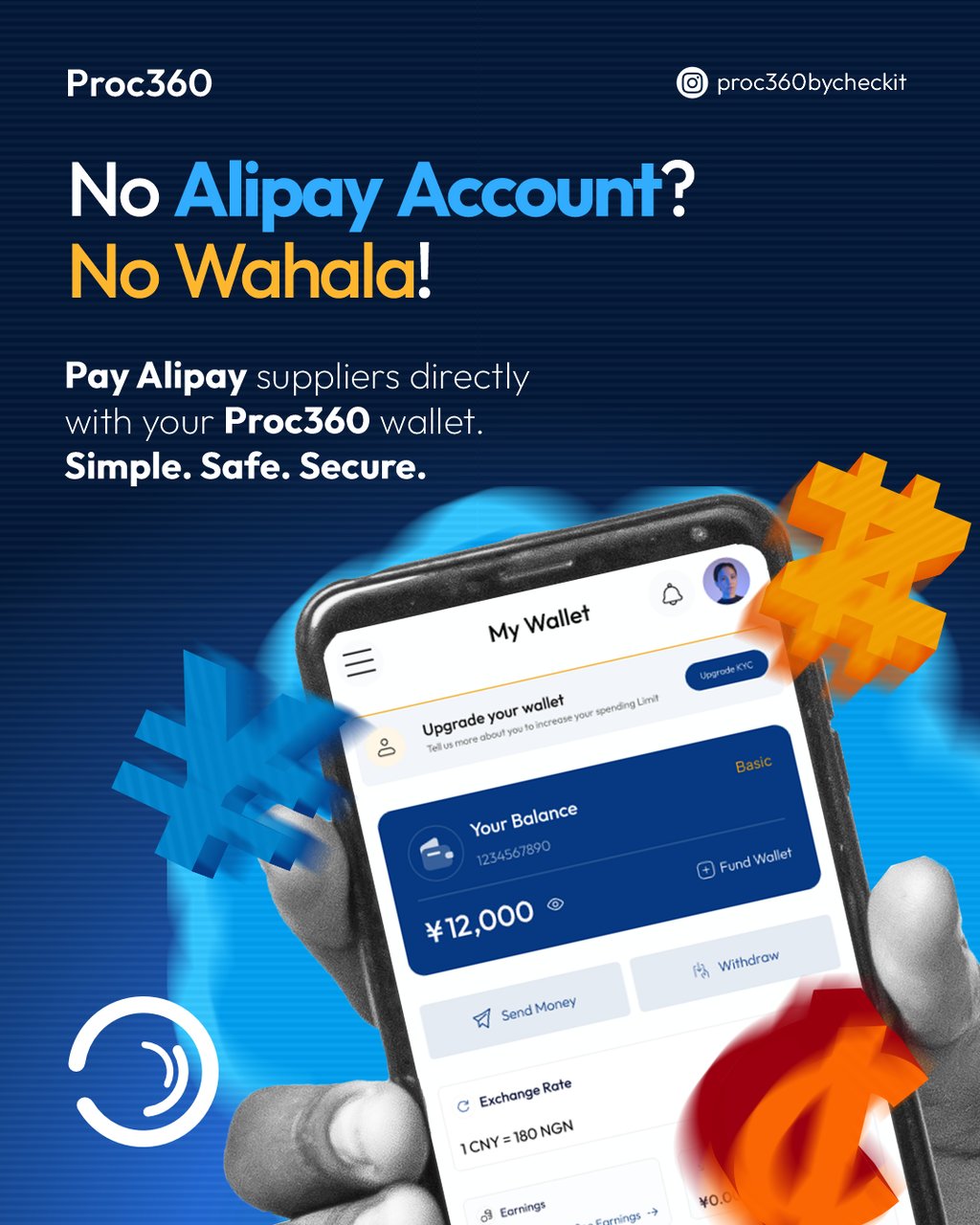
The safest approach is a platform built specifically for the China-Nigeria payment corridor — one that holds your money in RMB, converts at a transparent rate, and pays your supplier directly, so there is no unregulated middleman handling your funds.
The Proc360 Wallet works exactly this way. You fund your wallet in Naira, Dollars, or Cedi. The platform converts it to RMB at the real market rate — visible to you before you confirm. You pay your supplier directly from your dashboard, and every transaction is documented in your account history.
Key advantages over using a personal RMB agent:
Your funds are held in the platform, not a stranger’s personal account
Exchange rates are shown upfront with no hidden spread
You have a full transaction paper trail in your dashboard
You can store funds in RMB as a hedge against Naira devaluation
Transfer fee: 1.5% (capped at 100 CNY). Conversion: free
Fund your Proc360 Wallet in Naira and pay your Chinese supplier directly in RMB. Sign up for free →
Final Thoughts
RMB scams work because the payment gap between Nigeria and China is real — and scammers exploit every gap they find. The red flags are almost always visible before you send. The problem is most people either don’t know what to look for, or they spot the signs and proceed anyway because the deal feels urgent or too good to pass up.
It’s also worth remembering that losing money to a fake RMB vendor doesn’t just hurt your current order — it can set back your entire import business. The capital you lose is capital you can’t use to restock, expand your product range, or build the supplier relationships that make importing more profitable over time.
Slow down. Verify. And wherever possible, use a platform that protects your payment from the moment you send it to the moment your supplier confirms receipt.
Ready to stop worrying about RMB payment risk? Visit proc360.app to explore the Wallet feature, or sign up for free and start paying your suppliers safely today.