How to Ensure Product Quality When Importing from China: Inspections, Standards, and What to Do When Goods Arrive Wrong
Learn how to ensure product quality when importing from China. Discover inspection methods, supplier quality checks, certifications, and what to do if goods arrive wrong.
GROWING BUSINESSGETTING STARTED
Jacob Ehigie
5/18/20268 min read
Poor product quality is one of the most expensive mistakes a Nigerian importer can make, and it is almost always avoidable. The challenge is that by the time your goods land in Lagos and you discover a problem, your options are severely limited. You’re 11,000 kilometres from your supplier, you’ve already paid, and your goods have already cleared or are sitting at the port. Going back to the supplier for a resolution at that point is difficult, time-consuming, and rarely results in a full refund.
The only reliable strategy for product quality when importing from China is prevention. Every quality assurance tool that matters, samples, specifications, inspections, quality checks, must happen before your goods leave China. This guide covers exactly how to build that system, step by step, and what to do on the rare occasion that something still goes wrong after delivery.
Proc360 includes a quality check service for every order — request an inspection before your goods ship. Sign up for free →
Step 1: Define Your Quality Standards in Writing Before You Order
How do I protect product quality when ordering from a Chinese supplier?
The single most preventable cause of quality problems when importing from China is unclear expectations. A supplier in Guangzhou and a buyer in Lagos can have completely different definitions of “good quality” — and without written specifications, neither is technically wrong.
Before placing any order, prepare a product specification sheet that covers:
Materials and composition: exact fabric weight, plastic grade, metal type, or other material specifications
Dimensions and tolerances: exact measurements with acceptable variance ranges
Appearance standards: colour, finish, texture — matched to a physical sample or Pantone reference
Functional requirements: what the product must do, and how it must perform under use
Packaging specifications: carton dimensions, inner packaging, labelling requirements
Compliance certifications required: SONCAP, NAFDAC, CE, ISO — whatever applies to your product category in Nigeria
This document becomes your quality contract. Any deviation from it during production is a defect, not a matter of opinion. When you have specifications in writing, you have recourse. Without them, you have only the supplier’s word.
⚠️ Never rely on a product photo or a sample alone to communicate your quality standard. Images don't convey material weight, finish texture, or functional performance. Always back every sample with a written specification sheet.
Step 2: Request and Verify Samples Before Committing to a Bulk Order
How do I request samples from a Chinese supplier? Should I order samples before bulk?
Samples are your most important quality tool, and skipping them to save time or sample shipping cost is one of the most expensive shortcuts an importer can take. A bulk order of 500 or 1,000 units based on a product photo and a supplier’s assurance is a gamble — samples convert that gamble into a calculated decision.
Types of samples to request
Existing stock sample (ESP): a sample of what the supplier currently has in production. Use this to assess their baseline quality before investing in a custom order.
Pre-production sample (PPS): a sample produced from your specific specifications before full production begins. This is your golden sample — the benchmark every unit in your order must match.
Production sample: a random unit pulled from the production line mid-batch to confirm consistency is being maintained.
When your sample arrives, evaluate it against your specification sheet line by line — not just by feel or impression. Check the material, dimensions, colour match, stitching or assembly quality, and packaging. If anything deviates, go back to the supplier before production begins, not after.
✅ The golden sample you approve should be photographed from all angles and the photos stored in writing with your order records. If quality disputes arise later, this documentation is your evidence.
Product Test Reports and Nigerian Compliance: What to Check
What product certifications should I request from my Chinese supplier for importing to Nigeria?
For certain product categories entering Nigeria, passing a quality inspection is not enough. The Nigeria Customs Service, NAFDAC, and SON require specific product certifications and test reports before goods can legally clear. Getting these wrong means your goods are held at the port, regardless of how good they look.
Here is what to verify by product category:
Electronics and electrical goods: SONCAP (Standards Organisation of Nigeria Conformity Assessment Programme) certificate required. Products must be tested by an approved SONCAP certification body before export from China.
Food, beverages, cosmetics, drugs, medical devices: NAFDAC registration number required. Your supplier should have imported to Nigeria before or be willing to go through the NAFDAC product registration process.
Manufactured consumer goods: SON Standards Mark (MANCAP) certification may be required for some categories.
Electronics with batteries: Wh rating documentation required since China’s 2024 lithium battery export restrictions. Your supplier should provide a UN38.3 test report for lithium battery-containing products.
Request test reports from recognised third-party labs — SGS, Intertek, Bureau Veritas, or TÜV. Verify any report by searching the report number directly on the issuing lab’s website. A supplier who provides only self-issued test certificates with no third-party verification should be treated with caution.
What to Do When Your Chinese Supplier Sends Wrong or Defective Goods
What should I do if my Chinese supplier sends wrong goods or defective products?
Even with all the right precautions, problems occasionally get through. Here is the correct sequence of actions when goods arrive wrong or defective:
Document immediately: Document everything the moment the goods arrive or are unpacked. Photograph every defective unit, every incorrect item, every packaging failure. Date-stamp your photos. This documentation is your entire case — without it, you have no leverage.
Contact your supplier within the dispute window: Contact your supplier within the agreed dispute window — usually 7–14 days of receipt. Most supplier agreements and platform terms (1688, Alibaba Trade Assurance) require disputes to be raised within a specific window. Miss it and you lose your right to a formal resolution.
Present your evidence: Present your written specifications, golden sample photos, and inspection report (if you have one) alongside your defect documentation. Clearly state what was agreed and what was delivered. Ask explicitly for a replacement, rework, or partial refund based on the defect rate.
Escalate through platform dispute systems: If you ordered through Alibaba Trade Assurance or a platform with buyer protection, file a formal dispute through the platform. Alibaba’s Trade Assurance programme covers product quality disputes when the deviation from spec is documented. Escalate to Alibaba mediation if the supplier disputes your claim.
Use Proc360 order support: For goods ordered through Proc360, raise the issue through the platform’s order support. Proc360 works on your behalf to resolve supplier issues, which is a meaningful advantage over dealing directly with an unfamiliar Chinese supplier.
Be realistic about outcomes. A full refund is rare once goods have shipped. A partial refund or credit on the next order is the most common resolution for quality disputes where you have documentation but no pre-shipment inspection report. A replacement is most achievable when the defect rate is high and clearly documented before any goods are sold.
The lesson most importers learn after their first quality dispute is the same: the cost of a pre-shipment inspection is always less than the cost of a quality problem you didn’t catch in time.
Step 3: Use Factory Inspections to Catch Problems Before They Ship
How do factory inspections work when importing from China? What is a pre-shipment inspection?
Even with a perfect specification sheet and an approved golden sample, production errors happen. Materials get substituted. Quality fades as batches progress. Workers cut corners under time pressure. Factory inspections are how you catch these problems while you can still fix them — before the goods are packed into a container and shipped to Lagos.
There are three inspection stages, each catching different types of problems:
Pre-production inspection: happens before production begins. An inspector visits the factory to verify that the raw materials, components, and equipment match your specifications. This is the only stage where you can prevent defective inputs from entering production entirely.
During-production inspection: happens when 20–40% of production is complete. An inspector checks a sample of finished units against your golden sample and specification sheet. Any issues found at this stage can be corrected before the remaining 60–80% is produced — at far lower cost than a post-production correction.
Final pre-shipment inspection: happens when 100% of production is complete and at least 80% is packed. This is the most commonly requested inspection and the last line of defence before shipment. An inspector randomly selects units from packed cartons using internationally standardized AQL sampling, checks them against your specifications, and produces a written report with photographs.
Who conducts inspections?
Third-party inspection agencies are the industry standard. Internationally recognised firms like SGS, Intertek, Bureau Veritas, and QIMA send trained inspectors to Chinese factories and produce detailed, impartial written reports. Costs typically range from $250–$350 per inspection per factory per day, and the report gives you documented evidence to support any quality claim if problems emerge later.
For smaller orders where a full third-party inspection isn’t cost-justified, Proc360 offers an in-warehouse quality check at $0.50 per parcel — a practical entry-level verification step that confirms your goods match what you ordered before they leave the China warehouse.
Request a quality check on your Proc360 order before your goods ship from China. Start your order →
The Quality Fade Problem: Why Repeat Orders Sometimes Get Worse
What is quality fade when importing from China? Why is my supplier's quality getting worse?
Quality fade is one of the most insidious problems in China-to-Nigeria importing — and it affects repeat importers more than first-timers. Here’s how it works: your first order is excellent. Your second order is slightly different. By your fifth or sixth order, the product is noticeably cheaper-feeling than what you originally approved.
What’s happening is gradual, often deliberate substitution. The supplier replaces a more expensive material with a cheaper alternative. They reduce the number of stitches per centimetre. They use a thinner gauge of metal or plastic. Each change is small enough that you might not notice until several orders in — by which point you’ve potentially already sold products to customers who are now returning them.
The standard fix is to run a pre-shipment inspection on every single order — not just the first one. Many importers skip inspections after they “trust” a supplier. Quality fade specifically targets those importers. The other fix is to explicitly state in your purchase order that all specifications from your original golden sample apply permanently, and that any material substitution requires written approval.
⚠️ Quality fade is not always deliberate fraud — sometimes it's a supplier managing their own cost pressures. But the outcome for you is the same: goods that don't meet your standard. Inspection on every order is the only reliable protection.
Final Thoughts
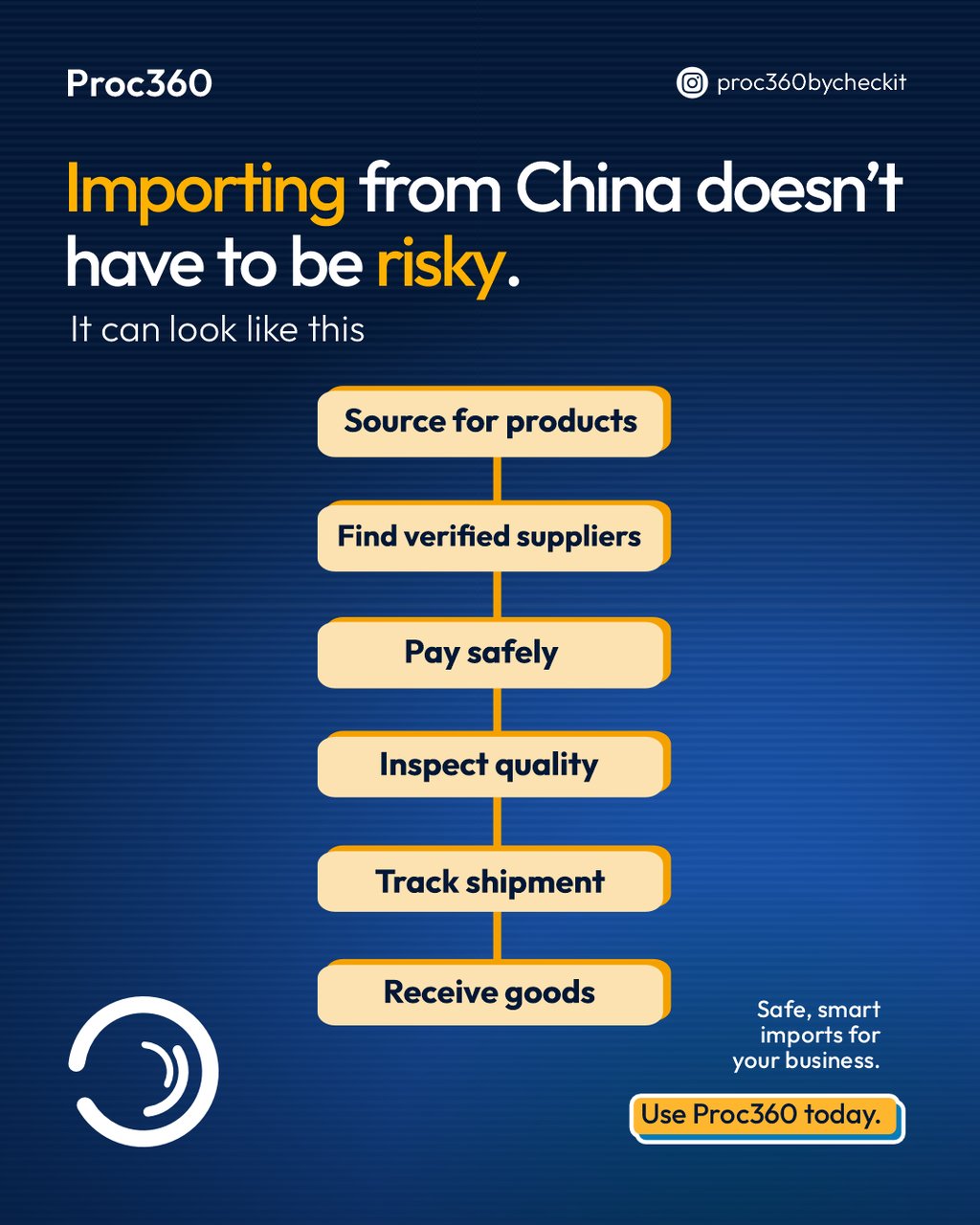
Quality control when importing from China is not a single action; it’s a system built across every stage of the order process. Clear written specifications before you order. Samples verified against those specifications before you commit. Inspections at the right stages of production. Compliance certifications confirmed before goods ship. And a quick, documented response if something still gets through.
The Nigerian importer who builds this system, even in a lightweight form, consistently gets better goods, has fewer disputes, and spends less time and money dealing with quality problems than one who relies on trust and luck. And trust, in international trade, is something you earn slowly through documentation — not something you extend blindly on the first order.
Ready to import from China with a quality check built into every order? Visit proc360.app to explore the quality check feature, or sign up for free and start your first order today.