How Nigeria's New $300 Duty-Free Threshold Affects Your Imports From China in 2026
Nigeria’s new $300 duty-free threshold lets importers avoid customs charges on small shipments. Learn what qualifies, limits, and how to use it in 2026.
GROWING BUSINESSGETTING STARTED
Jacob Ehigie
4/24/20265 min read
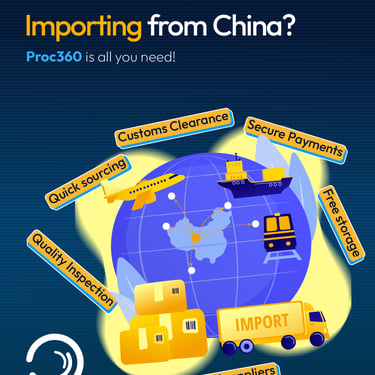
If you have been importing small quantities from China and paying customs duty on every single shipment, there is a policy change you need to know about. On September 8, 2025, the Nigeria Customs Service officially introduced a $300 de minimis threshold, meaning goods valued at $300 or less can now enter Nigeria completely free of import duties and taxes.
For mini importers, e-commerce sellers, and anyone testing new products in small batches, this is a meaningful cost saving on every qualifying order. With Proc360, you can source products from China, pay suppliers directly in RMB through the Wallet feature, and have goods shipped to Nigeria, with full transparency on your shipment value so you can plan around the threshold confidently.




What Is the $300 De Minimis Threshold?
De minimis is a legal term that means "too small to matter." In customs law, it refers to the value below which the government will not collect import duties or taxes, because the administrative cost of collecting the tax exceeds what is actually owed. Many countries already operate a version of this policy. The United States, for example, has a $800 de minimis threshold. South Africa and Kenya both have their own versions. Nigeria previously had no formally defined threshold, meaning officers at airports and ports used discretionary judgment, which created inconsistency, disputes, and unnecessary delays for low-value shipments.
The Nigeria Customs Service Board changed this at its 63rd regular meeting on September 2, 2025, approving $300 as Nigeria's official de minimis threshold, effective September 8, 2025. The decision was grounded in the Nigeria Customs Service Act, 2023, and aligns with both the World Trade Organisation Trade Facilitation Agreement and the World Customs Organisation Revised Kyoto Convention.
What Exactly Does the Policy Cover?
Understanding what qualifies under the threshold is important, because the exemption is more specific than many importers assume. Here is what the policy covers:
Goods valued at $300 or less. The exemption applies to the total declared value of the consignment, not per item. If your shipment is valued at $300 or below, no import duty or related taxes are charged.
Express shipments and courier deliveries. The threshold was specifically designed for goods arriving via express shipment channels — DHL, FedEx, UPS, and similar courier services. This is the primary route for small e-commerce purchases from China.
Passenger baggage. Items you bring back personally from abroad, valued at $300 or less, also qualify for the exemption. This has always existed informally but is now formally codified.
E-commerce consignments. The NCS explicitly designed this policy to support cross-border e-commerce, making it easier and cheaper for Nigerian businesses and consumers to receive small international orders.
What the Policy Does NOT Cover
This is the section most importers overlook, and it is where the real limits of the threshold become clear.
It is capped at 4 importations per person per year. You cannot use the $300 exemption on every single shipment indefinitely. Each individual or entity is limited to four qualifying importations per year under this threshold. On your fifth shipment, standard customs duty applies regardless of value.
Prohibited and restricted goods are excluded. Even if your goods are worth less than $300, if they fall on Nigeria's list of prohibited or restricted items, the exemption does not apply. NAFDAC-regulated products, certain electronics requiring SONCAP certification, and items on the restricted goods list still go through normal customs procedures regardless of value.
It applies to express shipments, not sea freight. The $300 de minimis threshold was designed for courier and express channels. If you are importing via sea freight — LCL or FCL — standard customs duty still applies regardless of shipment value. This means Nigerian importers doing bulk sea freight orders from China are not affected by this policy.
Invoice manipulation carries serious consequences. The NCS was explicit about this: any attempt to undervalue goods on invoices to fall below the $300 threshold constitutes fraud. Penalties under the NCS Act, 2023 include forfeiture of goods, arrest, and other sanctions. Do not ask your Chinese supplier to declare a lower value than the actual transaction amount.
Shipping costs, insurance, and fees are separate. The $300 refers to the declared value of the goods themselves, not your total landed cost. You will still pay courier fees, insurance, and any applicable handling charges. The exemption only covers customs duty and related taxes — not the shipping bill.
How Nigerian Importers Can Use This Practically
If you source small quantities from China — test orders, product samples, or fast-moving consumer items — the $300 threshold creates a real planning opportunity. Here is how to use it intelligently:
Use it for product testing. If you are trying a new product category for the first time, keep your initial order under $300 in declared value. You validate the market, avoid paying duty on a test run, and use one of your four annual exemptions wisely.
Time your shipments strategically. Because you only get four qualifying shipments per year, plan them around your most important import cycles — perhaps one per quarter. Use the exemption for your smaller, high-margin items and let larger bulk orders go through the normal duty process via sea freight.
Use courier or express shipping for qualifying orders. Since the threshold applies to express shipments, small orders that would previously come via air freight through courier services now have a potential duty saving of hundreds of naira. At the current exchange rate, $300 is roughly ₦480,000 to ₦510,000 — and duty on that value at a typical rate of 10 to 20% would have cost you ₦48,000 to ₦102,000 per shipment.
Keep your documentation accurate. The NCS has made clear that invoice manipulation will be prosecuted. The smarter approach is to structure your genuine orders to fall within the threshold where your actual purchase value allows it — not to falsify documents.
What This Means for Proc360 Users
If you source through Proc360's Buy For Me feature, you receive a detailed invoice for every order showing the exact value of goods purchased. That transparent documentation means you can accurately track which of your shipments qualifies under the $300 threshold and plan your import calendar around your four annual exemptions.
For orders that exceed $300 and will be shipped via sea freight — which covers most bulk import orders on Proc360 — standard customs duty still applies as normal. The threshold does not change the economics of large-volume sea freight importing. What it does do is make small test orders, product samples, and low-value replenishment shipments more cost-effective for importers who use courier and express channels for those specific needs.
The broader message is this: Nigeria's customs system is modernising, and the $300 de minimis threshold is one of several reforms making small-scale importing from China more accessible and less expensive. Understanding the rules — including the four-shipment annual cap and the express-only scope — is what separates importers who benefit from it and those who accidentally miss out or, worse, try to abuse it and face penalties.
Sourcing small quantities from China and want full visibility on your shipment values? Sign up on Proc360 and source, pay, and ship from China with transparent invoicing on every order — so you always know exactly where your imports stand.