Cheapest and Fastest Ways to Import Goods from China to Nigeria
Find the cheapest and fastest way to ship from China to Nigeria. Compare methods, calculate costs, and protect your profit on every order.
GROWING BUSINESSGETTING STARTED
Ugbe Zurishaddai
4/28/20266 min read
Shipping is where most Nigerian importers either protect their margin or quietly lose it. The product price you negotiated in China means very little if you're paying the wrong rate to move it here. This guide breaks down every shipping option from China to Nigeria; what each one costs, how long it takes, and which one makes sense for your order size.


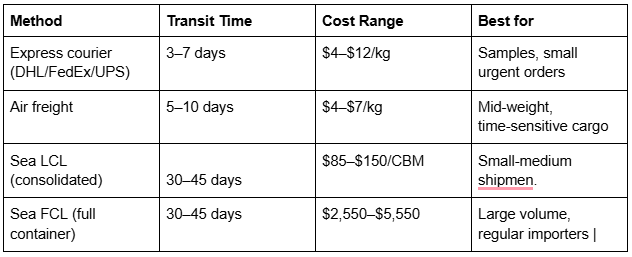
The Four Shipping Methods: At a Glance
How to Calculate Shipping Cost from China: A Practical Example
Say you're importing 500kg of phone accessories from Guangzhou.
Here's how to run the comparison:
Air freight option:
500kg × $6/kg = $3,000 freight
+ Customs clearance at Lagos: ~₦100,000
+ Last-mile delivery: ~₦50,000
Total: ~$3,000 + ₦150,000 | Timeline: 7–12 days
Sea LCL option:
Assuming 2 CBM at $120/CBM = $240 ocean freight
+ Nigerian port charges, clearing agent, delivery: ~$200–$400
Total: ~$500–$650 | Timeline: 40–55 days
At 500kg, the cost difference between air and sea is over $2,000 on a single shipment. That's the profit you keep or lose based solely on which box you tick at booking.
How to Reduce Shipping Costs from China
These strategies make a real difference over time:
1. Consolidate orders.
Shipping five small orders separately is almost always more expensive than shipping them together. Platforms with China warehouses like Proc360 let you accumulate stock and consolidate into a single shipment, saving on per-shipment fees, customs handling charges, and clearing costs.
2. Optimise your packaging.
Volumetric weight is the enemy of importers shipping bulky, lightweight goods. Work with your supplier to reduce carton dimensions. A 10% reduction in box size can meaningfully reduce your chargeable weight.
This is a service that's also offered on platforms like Proc360, helping you reduce costs.
3. Ship off-peak.
Freight rates spike predictably: Q4 (pre-Christmas globally), the run-up to Chinese New Year (January/February), and post-Golden Week restocking periods. Shipping in Q2 or Q3 typically gets you better rates and fewer delays.
4. Use a freight forwarder, not just a courier.
For shipments above ~50kg, a freight forwarder can access wholesale air and sea rates that aren't available if you book DHL directly. The difference can be $2–$5/kg, which becomes very significant at large volumes
5. Get multiple quotes.
Freight rates are not fixed. The same China–Lagos lane might be quoted at $5/kg by one forwarder and $7/kg by another in the same week. Getting three quotes before booking is a smart practice.
6. Track your shipment actively.
Delays at Lagos ports, whether from congestion, documentation issues, or customs inspection cost money in demurrage (container holding fees). Stay in contact with your clearing agent so you're not paying storage charges for goods sitting uncollected.
Or better still, use Proc360 for in built tracking, quick customs sourcing and free storage.


Option 2: Air Freight from China to Nigeria
Air freight sits between express couriers and sea freight in both cost and speed.
You're using the same planes, but through a freight forwarder rather than a courier's door-to-door network.
This means lower per-kg rates, but you take on more of the logistics coordination, like customs clearance, local pickup at the airport, last-mile delivery.
Transit time is usually around 5–10 days from China to Lagos (Murtala Muhammed International Airport)
Air freight makes sense when:
- Your shipment is 50kg–500kg
- Goods are time-sensitive but too heavy for cost-effective express delivery
- The product has high value relative to weight (profit margin absorbs the freight cost)
What to watch out for: Nigerian customs clearance for air cargo can add 2–5 days on top of transit time, depending on documentation and port activity at the time. Budget for this when promising delivery timelines to customers.
Option 3: Sea LCL (Less than Container Load) — The Cheapest Option for Mid-Size Shipments
LCL is consolidation shipping. Your cargo shares a container with other importers' goods, so you pay only for the cubic metres (CBM) your shipment occupies, not for an entire container.
Transit time is about 30–45 days from South China (Guangzhou/Shenzhen) to Lagos. Add 5–10 days for customs clearance and inland delivery.
How to calculate your CBM:
Length × Width × Height in metres = CBM
For example,
A shipment of 10 cartons, each 60 × 40 × 40cm:
Each carton = 0.6 × 0.4 × 0.4 = 0.096 CBM
10 cartons = 0.96 CBM — rounds up to 1 CBM minimum charge.
Note: Destination charges matter: LCL rates quoted by freight forwarders often cover China-side handling and ocean freight, but Nigerian port charges like terminal handling, delivery order fees, and customs clearance are additional.
Always ask for an all-in quote to Lagos Apapa or Tin Can Island port before comparing.
LCL makes sense when:
- Your shipment is 1–15 CBM
- You're not in a rush (30–45 days is the commitment)
- You want the cheapest per-unit shipping cost for non-urgent stock
LCL vs air freight
For shipments under roughly 300kg or under 1–2 CBM, air freight sometimes becomes cost-competitive with LCL once you factor in faster stock turnover and lower storage risk.
Run the numbers both ways on small shipments before defaulting to sea.
Option 4: Sea FCL (Full Container Load)
FCL means you book an entire container (20ft or 40ft) exclusively for your goods. The container is sealed in China and opened in Nigeria, reducing handling, theft risk, and potential damage from co-loading with other cargo.
Transit time is the same as LCL: 30–45 days from South China to Lagos.
Note: The gap between a 20ft and 40ft container in cost is smaller than the gap in capacity.
A 40ft container holds roughly double the volume for only 10–30% more in freight.
For importers with more volume, a 40ft is usually the better value.
FCL makes sense when:
- Your cargo exceeds 15–22 CBM (at that volume, FCL is cheaper per CBM than LCL)
- You're shipping regularly and want to reduce handling risk
- You're importing a full product line or doing a large seasonal stock-up
What about Guangzhou specifically?
Shipping from Guangzhou (or nearby Shenzhen) to Lagos is one of the most active China–Nigeria trade lanes. South China ports typically offer shorter transit times than East China ports (Shanghai, Ningbo) because they're closer to the main transhipment routes to West Africa.
The Bottom Line
The mistake most importers make isn't choosing the wrong method once, it's never building a comparison model, so they default to express couriers for shipments that would be dramatically cheaper by sea.
Build the habit of running the numbers on every order, and choosing the model that works for your business.
Remember, when in doubt, use Proc360 for a seamless, safe import.

*These are reference ranges for 2026. Actual rates shift with fuel surcharges, port congestion, seasonal demand, and carrier availability. Always get a live quote before booking.
Option 1: Express Courier — Fast, but Expensive
Express shipping is the fastest way to move goods from China to Nigeria.
It covers pickup, customs, and delivery in one flow.
It's best for speed, not for cost efficiency.
At $4–$12/kg, this is where many businesses unknowingly lose profits, especially when it is used for shipments that don’t require urgency.
When express makes sense:
- Sample orders before bulk purchases
- High-value, lightweight goods (electronics components, jewellery, cosmetics)
- Urgent restocks where running out of stock costs more than the freight premium
- First orders with a new supplier, where speed and trackability matter
When it doesn't:
- Heavy, bulky, low-margin goods — shipping cost will eat your profit
- Orders above 100–200kg, where air or sea freight becomes significantly cheaper per kg