Why Big Importers Buy Directly From Chinese Factories — And How to Make the Switch
Discover why big importers buy directly from Chinese factories, how to avoid trading company markups, verify suppliers, negotiate factory prices, and increase import profits.
GROWING BUSINESSGETTING STARTED
Ugbe Zurishaddai
5/12/20268 min read
Every time you buy from a trading company instead of a factory, someone else is collecting a fee on your order. That fee — call it the middleman markup — is typically 15–30% on top of what the factory actually charges.
For a ₦5 million shipment, that's ₦750,000 to ₦1.5 million going to a supplier who made nothing, packaged nothing, and added no value to your goods.
Big Nigerian importers figured this out years ago. They buy directly from Chinese factories at factory prices and use that margin advantage to undercut competitors, offer better quality, or simply make more money on every shipment.
This guide explains the full picture: the real difference between factories and trading companies, how to tell them apart, how to negotiate factory prices, and when a trading company actually makes sense.
The Profit Math: What Factory-Direct Actually Means for Nigerian Importers
Here's a simplified example with real numbers:
Product: Phone accessories (phone cases, earphones, cables) Order size: 500 units per SKU
Factory Types: OEM, ODM, and Private Label Explained
When you access a real factory, three business models become available to you that are completely closed off when buying from a trader:
OEM (Original Equipment Manufacturer): You design the product and specifications; the factory manufactures it. You control everything: materials, dimensions, features, packaging. Common for brands that want a product built exactly to their specifications.
ODM (Original Design Manufacturer): The factory has existing product designs that you can customize. You can add your logo, change the colour, modify a feature. Faster and cheaper than full OEM because the base design already exists. This is the most practical starting point for Nigerian importers building their own brands.
Private Label: The factory's existing product, repackaged and branded with your name and logo. The simplest version of factory-direct: you take their proven product, make it yours, and sell it in Nigeria under your brand. Low risk, fast to market, and still at factory pricing.
These models are unavailable with trading companies. And it makes sense, a trader can't give you true customisation because they don't control production.
How to Negotiate Directly With a Chinese Factory
This is where most first-time importers hesitate. Factory negotiation sounds intimidating — a different language, a different culture, complex pricing. But factories expect negotiation. Here's the practical playbook:
Get quotes from at least 5 suppliers
Never negotiate with one factory. Contact 5–8 suppliers for the same product and the same specifications. This gives you real market pricing — the actual range at which the product is made — and creates competitive leverage. If one factory quotes significantly below all others, that's a red flag. The pricing floor is your baseline for negotiation.
Research 1688 first
Before approaching any supplier on Alibaba, search the same product on 1688.com. The 1688 price tells you what a Chinese domestic buyer pays. That's effectively the factory floor price. Your target in negotiation is somewhere between the 1688 price and the Alibaba asking price.
Lead with volume and long-term intent
Chinese factories are not interested in one-time buyers. They want stable, repeat customers who offer predictable production runs. Open your negotiation by signalling long-term intent:
"We're looking for a long-term supplier for this product. We plan to order [X] units initially to test the market, but our target is [Y] units per quarter by month 6."
Even if you're starting small, framing yourself as a future volume buyer changes the supplier's calculation.
Negotiate MOQ separately from price
Many importers try to lower both MOQ and price at the same time. This rarely works. Prioritise. If your main problem is capital (you can't afford 1,000 units), focus the negotiation on reducing MOQ — and accept a slightly higher unit price. If your margins are tight, focus on price — and accept the full MOQ.
MOQ tactics that actually work:
Accept the factory's standard packaging to reduce the MOQ (custom packaging often doubles it)
Split the MOQ across multiple colours or variants (500 total units instead of 500 per SKU)
Offer full payment upfront for small first orders (removes the factory's financial risk)
Negotiate MOQ per year, not per order ("We'll buy 3,000 units over the next 12 months")
The realistic range for price negotiation
Don't expect to negotiate 50% off a factory's quote. Reasonable negotiation typically lands 5–15% below the initial price for most products. Going beyond that usually means the factory cuts quality to recover margin.
The better negotiation strategy is to increase value, not just cut price:
Simplify your specifications (fewer components, standard materials)
Offer a faster payment schedule
Commit to a second order contingent on quality
Ask what's included — sometimes "lower price" means removing packaging, quality checks, or certifications
Never reveal your budget
If a factory asks how much you're prepared to spend, redirect: "That depends on the quality and terms you can offer." The moment they know your ceiling, they will quote right at it.
When a Trading Company Actually Makes Sense
Factory-direct isn't always the right move. Here's when working with a trading company is genuinely smarter:
You need multiple products from different categories: A factory makes one thing well. If you need phone accessories, kitchenware, and clothing in one order, a trading company that works with multiple factories can consolidate everything, saving you shipping costs and coordination headaches.
Your MOQ is too small for factories: Most genuine factories have MOQs that reflect their production economics. If you need 50 units, a trading company (or a sourcing agent who buys from 1688) is often your only realistic option.
You're testing a new product: Starting with a trading company for market validation, then switching to factory-direct once you have proven demand, is a sensible business sequence.
The price difference is small: On some commodity products — basic packaging materials, standard components — factories have thin margins and traders are efficient. The price difference might be 5–8%. The service quality from the trader may justify that gap.
Frequently Asked Questions
How do I know a factory isn't pretending to be one? Request their business license and check the Business Scope section for manufacturing language. Ask for a live video call on the production floor. Have your sourcing agent verify their registration in official Chinese business databases. No legitimate manufacturer will refuse a business license request.
What's the typical MOQ for a Chinese factory? It varies significantly by product. For standard products with no customization: 50–200 units. For OEM or ODM products: 500–1,000+ units. For private label (existing product with your branding): 200–500 units. MOQs are almost always negotiable, especially with long-term volume commitment.
Can I do OEM manufacturing on a small budget? Yes, if you focus on ODM (factory's existing design, your branding) rather than full OEM (your design from scratch). ODM requires t no tooling investment and lower MOQs. It's the most accessible entry point to branded private label importing from China.
Is it risky to bypass trading companies and go direct? The main risks are quality control and communication — both of which you manage through pre-shipment inspection and working with a sourcing agent who speaks Mandarin. With those in place, factory-direct is consistently more reliable, not less, because you have direct visibility into production rather than being filtered through a middleman.
How do I find genuine factories if not on Alibaba? 1688.com is where factories sell to domestic Chinese buyers. Your sourcing agent can access 1688 directly. Global Sources and Made-in-China also have more factory-to-importer listings than Alibaba, with different verification systems. Canton Fair (now accessible online) is another excellent route to verified manufacturers across categories.
The Difference Between Factories and Trading Companies.
Walk through any major marketplace like Alibaba, Global Sources, Made-in-China, and almost every supplier will claim to be a factory. The words "manufacturer," "factory direct," and "direct from source" are plastered everywhere.
The reality, based on sourcing industry data, is that only about 20% of suppliers on international B2B platforms are genuine factories. The rest are trading companies. Those are businesses that buy from factories and resell to you, with a markup built in.
Trading companies aren't necessarily scams. They often provide real value: English-speaking sales teams, lower minimum orders, multiple product categories from different factories under one roof, and easier communication. But they come at a cost.
A factory:
Makes the product from raw materials
Has production lines, machinery, and workers
Can customize products, adjust specifications, create OEM or private label products
Has a business license that includes words like "manufacturing" (制造), "production" (生产), or "processing" (加工)
A trading company:
Buys finished goods from factories (often on 1688) and sells them to you
Has a showroom or office, often no production equipment
Has a business license focused on "wholesale" (批发) or "import/export" (进出口)
Usually marks up 15–40% on factory price
May have limited ability to accommodate customizations or quality changes
The markup a trading company adds is your money, going nowhere. When you buy factory-direct, that margin stays in your pocket or flows to your customer as a better price.
How to Tell If You're Talking to a Factory or a Trader
This is where most importers get stuck. Factories often don't market themselves well. Traders are excellent at appearing to be factories. Here's how to see through it:
Check their business license (营业执照)
Request a copy of their business license. The "Business Scope" (经营范围) section tells you the truth. A factory's scope includes manufacturing-related language. A trader's scope mentions wholesale, import, and export — but not production. You can ask a Chinese-speaking contact or your sourcing agent to translate this section for you.
Ask specific production questions
Ask questions only a factory would know:
"What is your daily production capacity for this product?"
"What raw materials do you use and who are your suppliers?"
"Can we see your production floor on a video call?"
"How long does your production lead time take for 500 units?"
A genuine factory will answer these precisely and confidently. A trader will stall, give vague answers, or redirect to catalogue questions.
Request a live factory video call
Ask for a live video walkthrough of their production floor — unannounced if possible. A real manufacturer will have machines running, workers present, and goods in production stages. A trading company will either decline, send pre-recorded footage, or show you a showroom.
Check their Alibaba profile
Look at: years in business (3+ preferred), verified manufacturer badge, audit reports, transaction history, and whether their listed products span wildly unrelated categories. A genuine factory specializes. A trader sells everything from phone cases to furniture.
Check 1688
Search the same product on 1688.com. If you find the exact same listing — same photos, same specs, same product codes — at a significantly lower price, you're likely looking at a trader who sources from that 1688 factory.
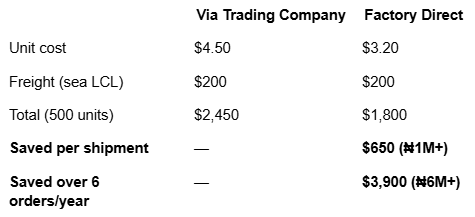
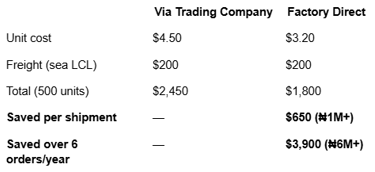
That ₦6 million per year is money that currently belongs to a trading company. Factory-direct moves it to you.
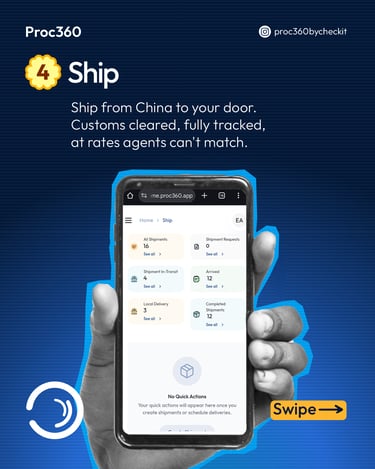
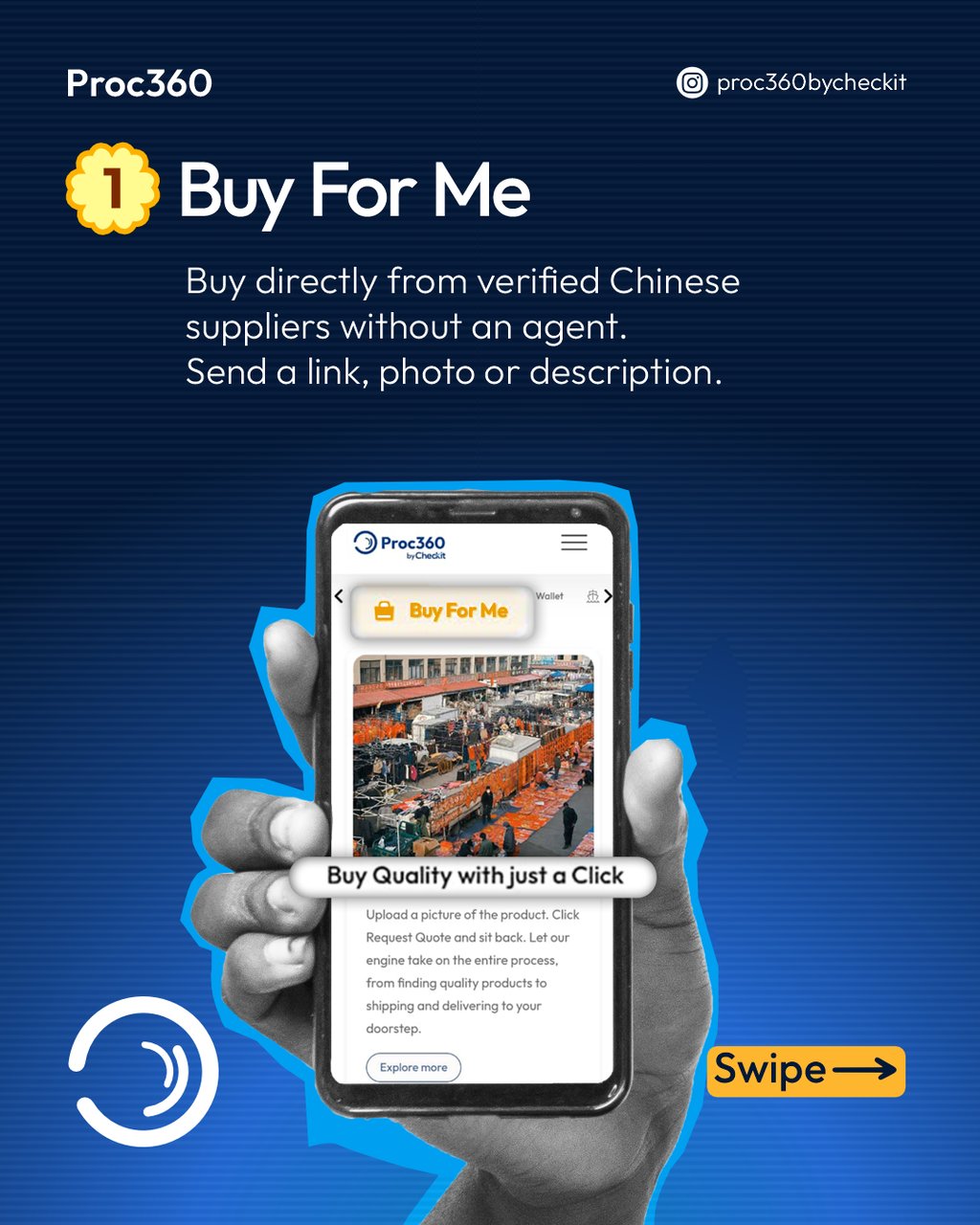
How Proc360 Gets You Factory-Direct Prices Without Traveling to China
Finding factories, verifying they're genuine, negotiating pricing in Mandarin, managing quality control, that's a lot to handle remotely from Nigeria.
Proc360 helps you shop from your home as if you’re in China.
This means you get access to verified suppliers, the best rates and inspection that ensures high quality of every shipment.
Ready to save funds and maximise profits? Import with Proc360.