What Happens to Abandoned Cargo at Nigerian Ports — And How to Avoid It
What happens to abandoned cargo at Nigerian ports, why shipments get stuck, demurrage costs explained, and how to avoid losing goods at Apapa and Tin Can Island ports.
GROWING BUSINESSGETTING STARTED
Ugbe Zurishaddai
5/22/20269 min read
Every year, millions of naira worth of goods sit abandoned at Apapa and Tin Can Island ports — not because the importers didn't want their goods, but because the costs of claiming them became higher than the goods were worth.
Demurrage piled up. Documentation errors delayed clearance. Duties turned out higher than expected. What started as a profitable shipment became a financial trap, and the importer walked away.
This guide explains exactly what happens to unclaimed cargo in Nigeria, the most common reasons goods get stuck or abandoned, what demurrage actually costs you, and how to protect every shipment from the moment it leaves China.
How Proc360's 30-Day Free Storage Protects Your Shipment
One of the most common ways Nigerian importers accumulate avoidable demurrage is when goods arrive in China before the importer is ready — the Form M isn't filed yet, the shipment isn't coordinated, or the timing doesn't line up.
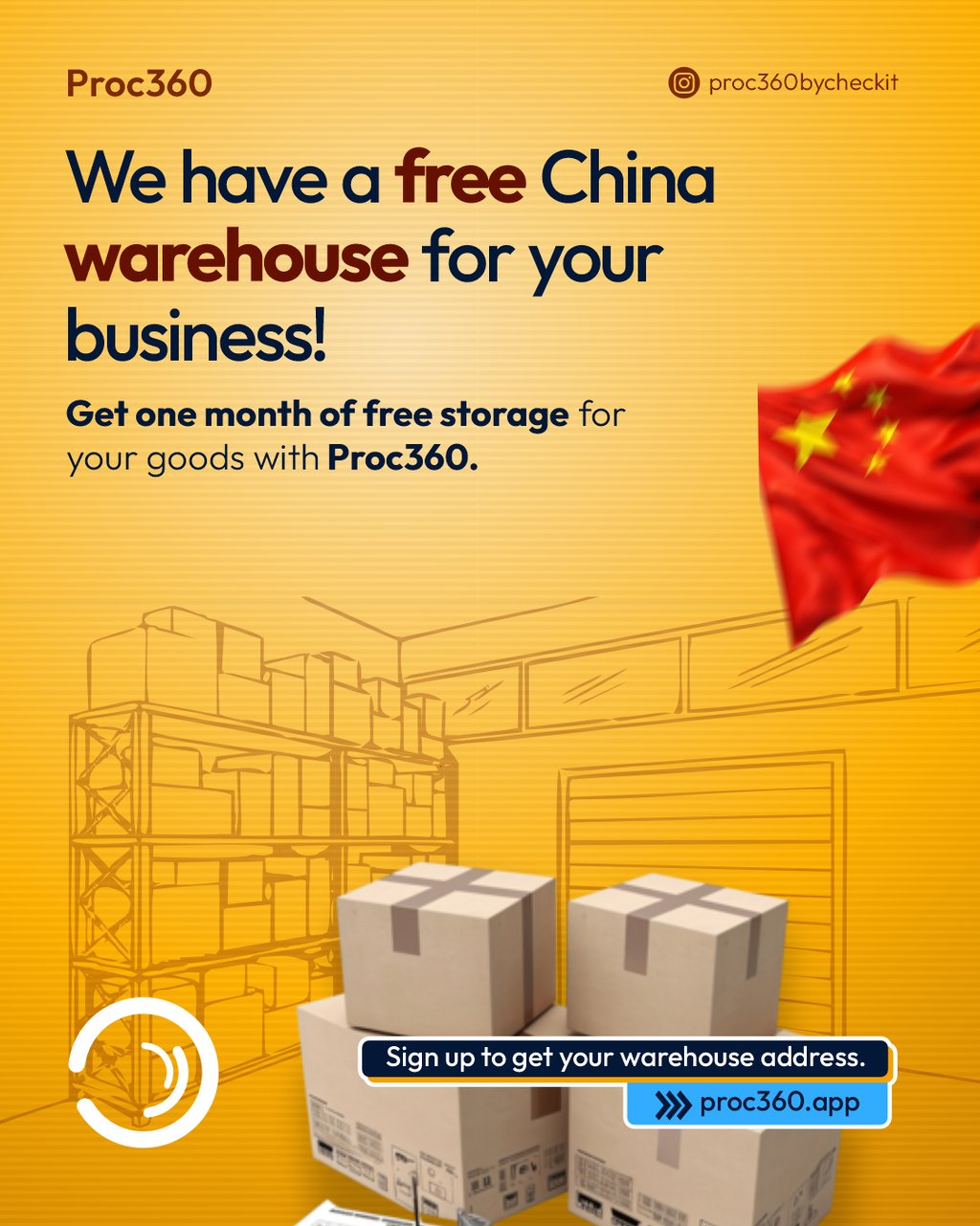
Proc360 includes 30 days of free storage at our Shenzhen warehouse before your goods are shipped.
This is a significant buffer that most importers don't have access to when ordering directly. Here's what it means in practice:
Your goods arrive at our warehouse from the factory
We inspect them and send you photos and video
You confirm quality and readiness
We coordinate the shipment to align with your Form M filing and port readiness in Nigeria
Goods only ship when you're prepared to clear them — not on the factory's schedule
Most demurrage situations at Nigerian ports begin in China, not in Nigeria. Goods ship before the importer is fully documentation-ready on the Nigerian side. By the time the vessel arrives, there's a scramble — and the clock is already ticking.
With Proc360's 30-day free storage, you control the timing. Your goods ship when your Nigerian clearing agent is ready, your PAAR process is initiated, and your Form M is confirmed. That coordination eliminates the most common demurrage trigger before it starts.
The Pre-Clearance Checklist: What to Have Ready Before Your Goods Arrive
Use this as a standard checklist for every shipment:
Documents (should be ready before the vessel arrives):
✅ Form M — filed and approved by your Authorized Dealer Bank
✅ PAAR — applied for and obtained (pre-arrival)
✅ Commercial invoice — matches actual goods exactly
✅ Packing list — consistent with invoice and Bill of Lading
✅ Bill of Lading — includes Form M number, shipped-on-board date, container number, weight
✅ Insurance certificate — from a NAICOM-licensed Nigerian insurer, at 110% CIF
✅ SONCAP Product Certificate — obtained in China before shipment
✅ NAFDAC permit — if importing food, drugs, cosmetics, or chemicals
Before the ship docks:
✅ Clearing agent engaged and briefed on shipment
✅ Duty amount estimated and funds available
✅ Haulage company identified and ready to mobilise
✅ Free days confirmed with your shipping line
✅ Demurrage rate known and budgeted if any
Don’t lose your goods and hard-earned money to easily avoidable situations. Import with Proc360 and enjoy free storage, proper documentation and overall imports without stress
Understanding Demurrage: The Clock That Never Stops
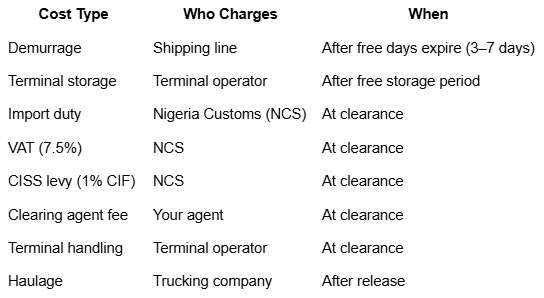
Demurrage is the daily charge levied by shipping lines and terminal operators when a container remains at the port beyond the agreed free period. It is separate from, and in addition to, import duties, clearing fees, and haulage.
The anatomy of port costs for an average shipment:
Frequently Asked Questions
Can I recover my goods after they've been classified as overtime? Yes, but the cost increases significantly. You'll owe all accumulated demurrage, terminal storage fees, plus a possible penalty for overtime classification. If the goods have already been gazetted for auction, you can still come forward to settle and claim them — but you must act before the auction date.
What if the delays were caused by a customs system failure? You can apply for a demurrage waiver from the shipping line or terminal operator, citing force majeure or system failure beyond your control. In practice, success rates vary. Some shipping lines offer partial waivers; others do not. The 2025 B'Odogwu crisis generated significant pressure on shipping lines for waivers, with partial success. Always document system failure delays officially through your clearing agent.
Can I just abandon my goods if the demurrage exceeds their value? Legally, abandonment does not extinguish your liability. The shipping line and customs can still pursue you for outstanding freight, demurrage, and duties — even after the goods are auctioned. If auction proceeds don't cover outstanding charges, you remain liable for the balance. Walking away is not a clean exit.
What is the difference between Apapa, Tin Can, and PTML ports? All three are in Lagos. Apapa (Lagos Port Complex) handles general containerized cargo. Tin Can Island handles both containers and bulk cargo. PTML (Ports and Terminal Multipurpose Limited) specializes in roll-on/roll-off vehicles. Most Chinese imports arrive at Apapa or Tin Can. Your freight forwarder will specify the port of discharge based on your cargo type and shipping line.
How do I find out if goods have been auctioned before I can claim them? NCS publishes lists of overtime and auctioned goods through its official channels and in national newspapers. Your clearing agent should also have access to terminal records. If you've lost track of a shipment, contact the shipping line with your Bill of Lading number — they can tell you the container's last known status.
What is Abandoned Cargo?
Cargo is considered abandoned when the consignee (the importer) shows no intention of taking delivery after a reasonable period. In Nigeria, the Nigeria Customs Service (NCS) classifies goods as "overtime cargo" after 28 days at the port without being cleared.
This triggers a formal process:
Day 1–28: Goods sit at the terminal. Demurrage charges accumulate from day one after the free period ends (typically 3–7 days depending on the shipping line). The importer receives notices to clear.
Day 29+: Customs officially classifies the cargo as overtime. It should be moved to the NCS bonded warehouse at Ikorodu Container Terminal, though in practice, due to high relocation costs, goods often remain at the port.
60-day grace period: After classifying as overtime, NCS gives owners another 60 days to come forward and clear the goods.
Public notice: If still unclaimed, Customs publishes a notice in newspapers and in the official government gazette.
Auction: After the gazetted notice, NCS proceeds to auction the goods. Proceeds go toward settling freight, storage fees, import duty, and auction costs. Anything remaining is refunded to the owner, or absorbed into government revenue if the owner can't be found.
Destruction: For prohibited goods, hazardous items, or goods with no auction value, Customs proceeds to destruction.
There are currently estimated to be over 7,000 overtime containers that have sat at Nigerian ports for years occupying terminal space and creating port congestion.
Why Do Nigerian Importers Abandon Their Cargo?
Understanding the causes is the first step to avoiding them. Most cases fall into one of these categories:
1. Demurrage exceeded the value of the goods: This is the most common scenario. The free period at Nigerian ports is very short. It is about 3–7 days depending on the shipping line. Once that window closes, demurrage charges begin accumulating daily. For a single 40-foot container, demurrage now averages ₦120,000–₦140,000 per day at Nigerian terminals. After 30 days, that's ₦3.6 million–₦4.2 million on top of whatever you owe in duties and clearing fees. For low-margin goods, it becomes cheaper to walk away.
2. Documentation errors delayed clearance: Missing or incorrect documents stall the PAAR (Pre-Arrival Assessment Report) process. Common issues:
Form M number missing or incorrect on the Bill of Lading
Mismatch between the commercial invoice and what was actually shipped
Wrong or missing HS codes (product classification numbers)
SONCAP certificate not obtained before shipment
Insurance certificate not meeting CBN's 110% CIF requirement
Every document error adds days, and demurrage doesn't pause while you fix paperwork.
3. Wrong HS code triggered a higher duty than expected: The HS code (Harmonized System code) determines your import duty rate. Nigeria's duty rates range from 0% to 35% of the CIF value, plus surcharges, levies, and 7.5% VAT. A wrong HS code can mean you arrive at the port expecting to pay 5% duty and discover your goods are classified at 20% or 35%. Some importers, upon seeing the actual duty bill, decide the goods are no longer worth clearing.
4. Goods included prohibited or restricted items: Nigeria maintains a list of prohibited imports. These are goods that cannot legally enter the country. Items on the absolute prohibition list include certain agricultural products, counterfeit goods, used tyres, and others. If prohibited items are found in a shipment, the entire container can be seized. Some importers abandon cargo rather than face legal consequences.
5. Supplier shipped different goods than what was declared: This happens more than people admit. The supplier sends goods that don't match the invoice or packing list. At the port, customs inspects and finds a discrepancy. The importer, who genuinely didn't know, is now facing misdeclaration charges and must either pay fines and duty on the actual goods, or walk away.
6. The importer ran out of funds mid-process: The clearing process requires payment in a specific sequence: duties, terminal handling charges, demurrage, freight agent fees, then haulage. If the importer doesn't have liquidity to cover all of these simultaneously, the goods sit while money is being arranged, and demurrage keeps growing.
7. System failures at the port: In 2025, Nigeria's ports experienced a significant crisis when the NCS's B'Odogwu digital platform suffered extended network failures. Over 5,000 containers were trapped at Apapa, Tin Can, PTML, and Onne ports, with importers accumulating an estimated ₦2 trillion in demurrage, not through any fault of their own, but because customs could not process payments or issue PAARs. Some of those shipments were eventually abandoned.
What demurrage costs in real numbers:
The daily demurrage rate at major Nigerian ports for a 40-foot container is currently ₦120,000–₦140,000. For vehicles and rolling stock, NCS-quoted rates run approximately:
₦10,000/day for cars
₦35,000/day for trucks
₦45,000/day for heavy equipment
These charges escalate after the initial grace period. Shipping lines like Maersk, MSC, CMA CGM, Hapag-Lloyd, and COSCO all have their own tariff schedules, and they do not pause charges for customs system failures, public holidays, or documentation disputes.
Demurrage vs. Detention — the distinction matters:
Demurrage = charges for keeping the container inside the terminal beyond free time
Detention = charges for keeping the container (empty or full) outside the terminal beyond free time (e.g., at your warehouse)
Both apply. Both accumulate. Both must be paid before the container can be returned.
The Clearance Timeline You Need to Understand
Most importers underestimate how fast the clock runs at Nigerian ports. Here's the actual sequence:
Before the vessel arrives:
File Form M with your Authorized Dealer Bank (must be done before goods ship)
Obtain SONCAP certificate (done in China before shipment)
Prepare all shipping documents: commercial invoice, packing list, Bill of Lading, insurance certificate
Submit PAAR application through your bank/clearing agent
PAAR should be obtained before the vessel arrives — this is called pre-arrival clearance
When the vessel arrives:
Free period begins: typically 3–7 days depending on the shipping line
This is the only window to clear without demurrage
After free period:
Demurrage begins at the terminal daily rate
Every day of delay adds cost
Documentation errors now have a financial penalty attached to every hour of resolution
When clearance is complete:
Pay duties, handling fees, and any demurrage owed
Obtain Terminal Delivery Order (TDO)
Arrange haulage to your warehouse or destination
The entire pre-arrival process — PAAR submission, document preparation, duty calculation — should ideally be complete before the ship docks. Importers who start this process after the goods arrive are almost guaranteed demurrage charges.
The Most Common Documentation Errors That Cause Delays
Wrong or missing HS code: Your goods' HS code determines your duty rate, regulatory requirements, and import restrictions. A wrong code doesn't just affect your duty, it can trigger a physical customs inspection, which adds days. Always verify your HS code with your clearing agent before the shipment leaves China.
Form M number not on the Bill of Lading In Nigeria, the Form M number must appear on the Bill of Lading. If your supplier doesn't include it, maybe because they don't know, or because you didn't inform them, the B/L must be amended, which takes time and costs money.
Mismatch between invoice and actual goods: The commercial invoice, packing list, and actual goods must match exactly. Weight, quantity, description, HS codes — all consistent. Even minor discrepancies can trigger a customs hold for physical inspection.
No SONCAP certificate (or the wrong one): Most goods imported from China into Nigeria require a SONCAP Product Certificate (PC) which must be obtained in China before shipping. If this is missing, your goods cannot be cleared. You'll have to apply for a default SONCAP, which takes time and costs more than getting it right the first time.
Foreign insurance certificate: As we covered in our insurance guide, Form M requires a Nigerian insurance certificate. Submitting a supplier's CIF insurance will get your clearance blocked.